Choose the Perfect Plant
This online tool is designed to help you find the native plants best-suited for specific sites that provide the greatest ecological function and benefit, and that will also complement your Cape Cod landscape design. Using the dropdowns below, you have the ability to find plants based on these six criteria: Plant Type, Sunlight, Soils, Bloom Month, Size, and Nature Benefits. Based on your choices, the results will automatically populate.
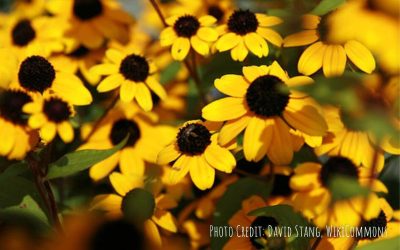
Three-Lobed Coneflower
Rudbeckia triloba
Growing Information
• Plant Type: Perennial
• Sunlight: Sun to Part Shade
• Soils: Average to moist soils
• Bloom Time: Yellow flowers from June to October
• Size: 2-5 feet in height,1-3 foot in spread
This showy perennial is native to much of the Northeast, however it is introduced in Massachusetts. This bright and colorful species is highly ornamental, making a great addition to a garden setting, especially when planted in masses. While this plant prefers some moisture, it can handle the dry soils of the Cape when put in partial shade. This species does self-seed and can easily spread to fill in a garden bed area.
Garden Companions
Great Blue Lobelia (Lobelia siphilitica), New York Aster (Symphyotrichum novi-belgii)
Nature Benefits
- Flowers provide nectar to a variety of pollinators.
- Songbirds and small mammals eat the seeds.
Natural Habitat
Meadows and fields, roadsides and human disturbed sites.
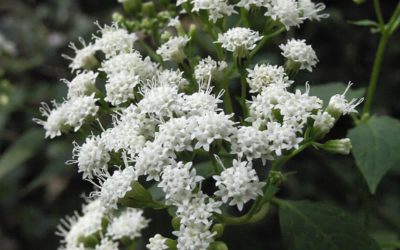
White Snakeroot
Ageratina altissima
Growing Information
• Plant Type: Perennial
• Sunlight: Sun to Part Shade
• Soils: Dry to moist.
• Bloom Time: White flowers from late July through October
• Size: 2-3 feet in height, 1-2 foot spread
Often seen on woodland edges, this is a great plant for the edges of meadows or as a transition out from underneath trees. It’s long bloom time gives this plant a long season appeal, with snowy clusters of white flowers. This species can seed itself around, as well as spread by rhizomes, making it a good competitor in a woodland edge setting. Please note that this plant is poisonous to digest and should not be planted where cows or goats graze to prevent milk sickness.
Garden Companions
Common Yarrow (Achillea millefolium), Zigzag Goldenrod (Solidago flexicaulis)
Nature Benefits
- Songbirds eat the seeds.
- Host plant for the Dusky Groundling moth (Condica vecors)
- Flowers provide nectar to a variety of pollinators, especially liked by leaf-cutting bees and smaller butterfly species.
Natural Habitat
Woodland edges.
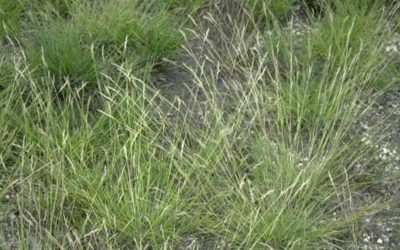
Poverty Grass
Danthonia spicata
Growing Information
• Plant Type: Perennial
• Sunlight: Sun to full shade.
• Soils: Dry
• Bloom Time: Non-showy green inflorescence from May to July.
• Size: 1-3 feet in height, 1-2 foot spread
Despite its name, this grass offers an abundance of beauty to a garden setting. Tolerant of the dry sandy soils of the Cape, this grass is a perfect groundcover for sun or shade. Its low growing nature makes it a great lawn alternative. Unlike many of our native grasses, such as little bluestem or purple lovegrass, which don’t show themselves until June, this is a cool season grass to give your garden a nice spring green. It will then make itself scarce once the summer heat comes on.
Garden Companions
Black Oak (Quercus velutina), White Wood Aster (Eurybia divaricata)
Nature Benefits
- Host plant for the and Indian Skipper, Common Wood-Nymph, Leonard’s Skipper, and Hobomok Skipper butterflies.
- Songbirds eat the seeds.
Natural Habitat
Meadows and fields, rocky slopes, woodlands.
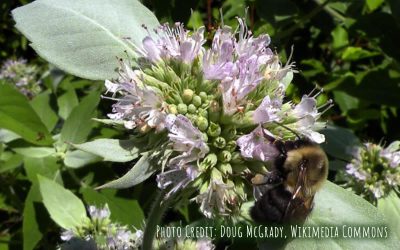
Hoary Mountain Mint
Pycnanthemum incanum
Growing Information
• Plant Type: Perennial
• Sunlight: Sun to part shade.
• Soils: Dry to moist.
• Bloom Time: White to light purple flowers from June through July.
• Size: 2-4 feet in height, 1-3 foot spread
Like our other native mints, this plant is great for a garden full or deer or rabbits, as the smell and taste of this plant makes it undesirable to browse. In summer it flushes with large clusters of white/light purple flowers, which are loved by pollinators: a Barnstable County native.
Garden Companions
Showy Goldenrod (Solidago speciosa), Aromatic Aster (Symphyotrichum oblongifolium)
Nature Benefits
- Host plant for the Tobacco Budworm, Curved-toothed Geometer, Hermit Sphinx, and Wavy-lined Emerald moths.
- Flowers provide nectar to a variety of pollinators, particularly smaller butterflies like Hairstreaks.
Natural Habitat
Woodland edges, cliffs or rocky ledges.
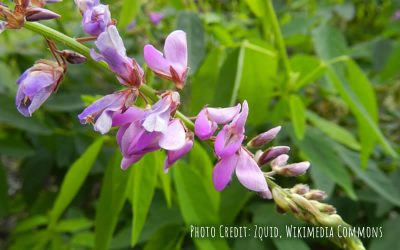
Showy Tick-Trefoil
Desmodium canadense
Growing Information
• Plant Type: Perennial
• Sunlight: Sun
• Soils: Dry to moist.
• Bloom Time: Pink flowers from June to September
• Size: 2-3 feet in height, 1-2 foot spread
As the name implies, this plant offers showy pink flowers from mid-summer to fall, making this plant a great addition to a sunny spot. Extremely tolerant of poor, sandy soils, this plant is happy to spread itself around and looks great in a cluster. This is a Barnstable County native.
Garden Companions
Grass-leaved Goldenrod (Euthamia graminifolia), Appalachian Mountain Mint (Pycnanthemum flexuosum)
Nature Benefits
- Host plant for the Eastern Tailed Blue, Silver-spotted Skipper, Southern Cloudywing, Northern Cloudywing, and Hoary Edge butterflies as well as the Pink-washed Aristotelia, Tobacco Budworm, Batman, and Tick-Trefoil Caloptilia moths.
- Flowers provide nectar to a variety of pollinators, with special value to bumble bees.
Natural Habitat
Meadows and fields, shores of streams or ponds.

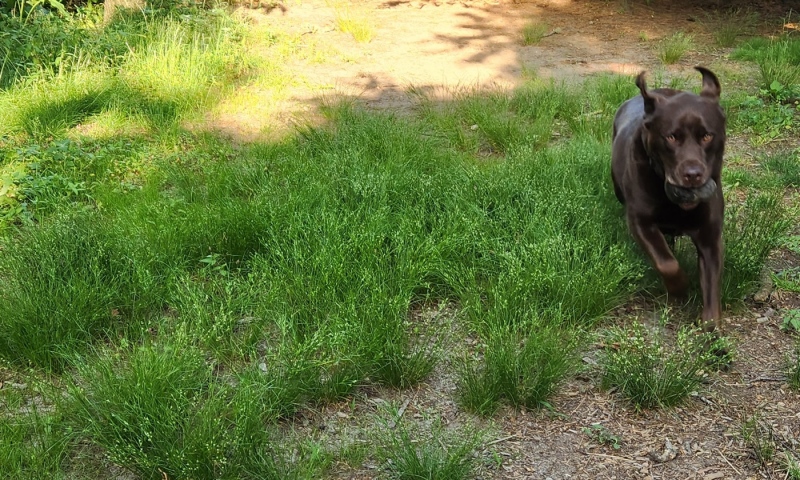
Path Rush
Juncus tenuis
Growing Information
• Plant Type: Perennial
• Sunlight: Part shade, Sun
• Soils: Average, moist, dry
• Bloom Time: July-August
• Size: 4-18 inches in height
Path rush is a hardy native rush that grows anywhere. It forms dense tufts with stiff green stems. The tiny flower, termed an inflorescence, blooms mid to late summer. The name path rush refers to its hardiness to foot traffic along pathways and thus can make a good rough lawn. Incredibly tolerant to compacted soil and will grow where other things cannot, but it also can help uncompact soil to be more favorable to other plants. It’s good in rain gardens and other areas to cover the ground as that first layer. It’s dog tough and deer resistant.
Garden Companions
In a rain garden: Blue Flag Iris (Iris versicolor), Red Cardinal Flower (Lobelia cardinalis), Rose Milkweed (Asclepias incarnata)
Nature Benefits
• Supports birds with seeds and nesting material
Native Habitat
Occurs in open woodlands, freshwater wetlands, thickets, meadows, compacted foot paths, parking lots, fields, pastures, barren waste areas and roadsides.
Photos

Common Yarrow
Achillea millefolium
Growing Information
• Plant Type: Perennial
• Sunlight: Sun
• Soils: Prefers well drained, dry to medium soils but can generally tolerate a wide range of soils if drainage is adequate.
• Bloom Time: white to pink flowers from June to September (other colors are cultivated varieties)
• Size: 1-2 feet in height; 2-3 foot spread
Common Yarrow is an herbaceous perennial found on Cape Cod and across North America. It prefers disturbed areas, meadows, and roadsides. Yarrow can be identified by their feathery, alternate leaves and small white flowers arranged in clusters at the top, attracting a variety of pollinators. This plant has a rhizomatic root system and can be seen growing upright, spreading, or densely dispersed across an area.
Garden Companions
Common Milkweed (Asclepias syriaca), Wild Bergamot (Monarda fistulosa)
Nature Benefits
• Attracts a variety of pollinators
• Tolerates deer and drought
Native Habitat
Meadows, lawns, fields, roadsides.

Scarlet Oak
Quercus coccinea
Growing Information
• Plant Type: Tree
• Sunlight: Sun
• Soils: Dry to moist, well drained soils. Prefers dry, acidic, sandy soils.
• Bloom Time: Non-showy yellow catkins in April and May
• Size: 50-80 feet in height; 10-20 foot spread
As the name suggests, this oak is best known for its stunning red color in the fall, which easily sets it apart from red oak (Quercus rubra) and black oak (Quercus velutina). Scarlet oak also features a rounded canopy and is fast growing compared to other oaks, making it a great choice for ornamental landscapes. This is a very common tree throughout the Cape’s woodlands, as it is able to handle harsh, sandy conditions.
Garden Companions
Plantain-Leaved Pussytoes (Antennaria plantaginifolia), Silverrod (Solidago bicolor)
Nature Benefits
• Acorns provide food for a variety of wildlife.
• Serves as host plant for many species of butterflies and moths.
Native Habitat
Dry, sandy woodlands and forests.

Black Oak
Quercus velutina
Growing Information
• Plant Type: Tree
• Sunlight: Sun
• Soils: Prefers rich, well drained soils, but is highly adaptable to dry sandy soil as well.
• Bloom Time: Non-showy yellow catkins in April and May
• Size: 50-80 feet in height; 10-20 foot spread
Black oak is extremely similar to many of the other oak species on the Cape, such as Northern red oak (Quercus rubra) and Scarlet Oak (Quercus coccinea), but has a few distinguishing features. When the leaves first emerge each spring, they are slightly fuzzy, covered in small hairs, this is where the species name, velutina, comes from. Additionally, the bark features deep black fissures that set this tree apart from other oaks. But like all oaks, black oaks provide incredible benefits as a host to a variety of beneficial insects.
Garden Companions
American Beech (Fagus grandifolia), Beaked Hazelnut (Corylus cornuta)
Nature Benefits
• Acorns provide food for a variety of wildlife.
• Serves as an important host plant for numerous species of insects, which in turn are food for birds.
Native Habitat
Upland areas of forests and woodlands.
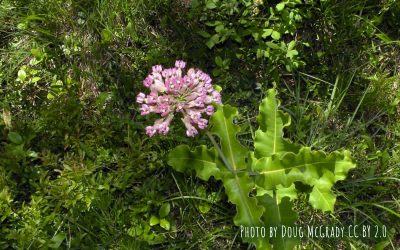
Clasping Milkweed
Asclepias amplexicaulis
Growing Information
• Plant Type: Perennial
• Sunlight: Sun
• Soils: Average to Dry
• Bloom Time: May-June
• Size: 1-2 feet in height; 1-2 feet spread
This uncommon Cape Cod native plant grows naturally in open fields or roadsides and prefers sandy soils. It is distinguished from Common Milkweed by its nearly clasping leaves. The leaves will abut around the stem but are not fused together. Like other milkweeds, this plant provides tremendous benefits to pollinators, such as specialty bees and, of course, monarch butterflies, and other insect species.
Garden Companions
Pearly Everlasting, (Anaphalis margaritacea), Purple Lovegrass (Eragrostis spectabilis)
Nature Benefits
• Special value to bumble bees.
• Supports other insects that are predators of pest insects.
• Host to monarch butterflies
Native Habitat
Occurs in dry grasslands, meadows, fields, and roadsides.
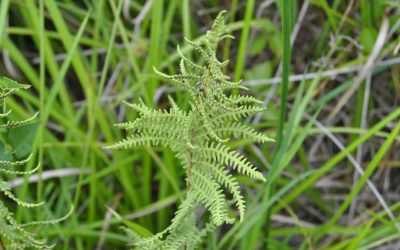
Marsh Fern
Thelypteris palustris
Growing Information
• Plant Type: Perennial
• Sunlight: Sun
• Soils: Medium moisture to Wet
• Bloom Time: N/A
• Size: 1-2 feet in height; 1-2 foot spread
This native fern grows in wet meadows or on the shores of rivers and streams. It is fairly easy to distinguish, because of its upright form and folded pinnule (leaf) margins. It has one look-alike, the Massachusetts fern, and the two can be singled out by looking at the lowest pair of pinnae (leaves). These pinnae on the Massachusetts fern point downward and on marsh fern they do not.
Garden Companions
Meadowsweet (Spirea alba), New York Ironweed (Vernonia novaboracensis)
Nature Benefits
• Stabilizes shores and banks.
• Only known host plant of the Marsh Fern Moth (Fagitana littera)
Native Habitat
Occurs in marshes and wetland margins, shores of rivers and ponds
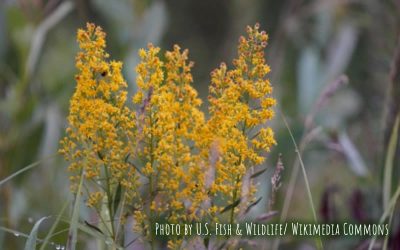
Showy Goldenrod
Solidago speciosa
Growing Information
• Plant Type: Perennial
• Sunlight: Sun
• Soils: Dry to moist
• Bloom Time: Showy yellow flowers from August to September
• Size: 3-5 feet in height, 1-2 foot in spread
As the name suggests, this is one of the showier goldenrods. A native to Massachusetts, this plant is often added to pollinator gardens, but is naturally found in meadows. This species is tolerant to a variety of conditions such as dry, nutrient poor soils, as well as slightly moist, nutrient rich soils.
Garden Companions
Black-Eyed Susan (Rudbeckia fulgida), Purple Coneflower (Echinacea purpurea)
Nature Benefits
• Flowers provide nectar to a variety of pollinators.
• Host Plant for the Wavy-lined Emerald butterfly.
• Seeds are eaten by songbirds and small mammals.
Native Habitat
Meadows and fields.
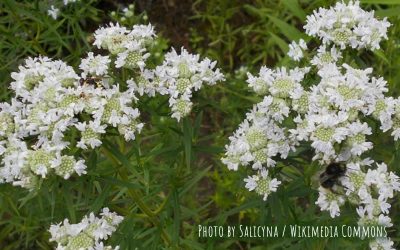
Virginia Mountain Mint
Pycnanthemum virginianum
Growing Information
• Plant Type: Perennial
• Sunlight: Partial Shade
• Soils: Average to moist
• Bloom Time: White flowers from July to August
• Size: up to 3 feet in height, 1-2 foot in spread
Don’t be deceived by this plant’s common name, as this mint is typically found in low-lying wet meadows, wetlands, and along streams and ponds. This mint takes on a bushier form than
some of the other native mints, making it a nice addition to a meadow or naturalized area. The strong minty smell that the leaves emit when crushed is great for preventing browse from rabbits and deer.
Garden Companions
Turtlehead (Chelone glabra), Red Cardinal Flower (Lobelia cardinalis)
Nature Benefits
• Flowers provide nectar to a variety of pollinators.
Native Habitat
Wet Meadows and fields, wetland edges, shores of lakes or rivers.
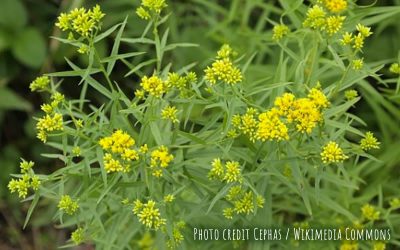
Grass-leaved Goldenrod
Euthamia graminifolia
Growing Information
• Plant Type: Perennial
• Sunlight: Sun
• Soils: Average to moist soils
• Bloom Time: Yellow flowers from July to September
• Size: 2-4 feet in height, 1-2 foot in spread
This is a common goldenrod, typically found in open meadows and fields, as well as the shores of rivers and lakes. This species can tolerate some wetter soil but requires full sun. While it spreads by root, it’s not aggressive and will not colonize garden beds. It’s a true Cape Cod native.
Garden Companions
Appalachian Mountain Mint (Pycnanthemum flexuosum), Little Bluestem (Schizachyrium scoparium)
Nature Benefits
• Flowers provide nectar to a variety of pollinators.
• Seeds are eaten by the American goldfinch and the swamp sparrow.
Native Habitat
Open fields and meadows, shores of rivers or lakes, wetland margins.
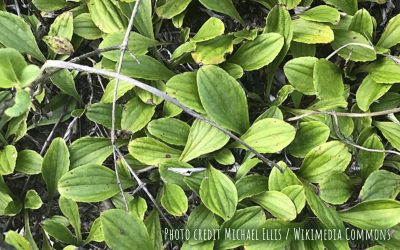
Plantain-leaved Pussytoes
Antennaria plantaginifolia
Growing Information
• Plant Type: Perennial
• Sunlight: Sun to Partial Shade
• Soils: Dry soil with little organic matter
• Bloom Time: Non-showy white or white/pink flowers from April to June
• Size: less than one foot in height
A great plant for dry conditions, as this species’ typical habitat is rocky/sandy slopes. Spreads through underground root structures and makes an excellent spreading/creeping groundcover. Male flowers are pure white, but female flowers feature a pink tinge.
Garden Companions
Eastern Prickly Pear (Opuntia humifusa), Wild Sundial Lupine (Lupinus perennis)
Nature Benefits
• Flowers provide nectar to a variety of pollinators.
• Host Plant for the American Lady butterfly.
Native Habitat
Dry rocky cliffs or ledges, sandy meadows and fields.

New York Aster
Symphyotrichum novi-belgii
Growing Information
• Plant Type: Perennial
• Sunlight: Sun to Partial Shade
• Soils: Average to Moist
• Bloom Time: Flower color varies from white to pink or violet, from July to October
• Size: 2-4 feet in height, 1-2 foot in spread
Typically found on the edges of forests, meadows, and marshes, this aster can handle a variety of conditions. This species can thrive in either full or part sun and doesn’t mind sitting in moist soil. The flower color is highly variable, and can be either white, pink, blue, or violet. It is a Cape Cod native.
Garden Companions
Foxglove Beardtongue (Penstemon digitalis), Common Boneset (Eupatorium perfoliatum)
Nature Benefits
• Flowers provide nectar to a variety of pollinators.
• Host plant for the Pearl Crescent butterfly.
• Songbirds and small mammals eat the seeds.
Native Habitat
Edges of forests, meadows and fields, shores of rivers or lakes.
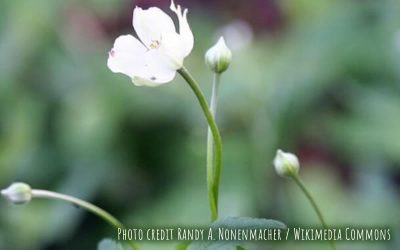
Tall Anemone
Anemone virginiana
Growing Information
• Plant Type: Perennial
• Sunlight: Sun to Partial Shade
• Soils: Average to Moist
• Bloom Time: White flowers from May to July
• Size: up to 3 feet in height, 1-2 foot in spread
This plant offers a great late spring bloom to kick off the ground season. It prefers slightly shady woodland edges, but will tolerate full sun if the soils are moist. While this anemone is not as aggressive as others in this genus, the plant will still spread via underground root structures. Be sure to wear gloves when pruning as the sap can cause minor irritation. This is a true Cape Cod native.
Garden Companions
Quaking Aspen (Populus tremuloides), Swamp Rose (Rosa palustris)
Nature Benefits
• Flowers provide nectar to a variety of pollinators.
• Seeds are eaten by songbirds and small mammals.
Native Habitat
Forest edges, shores of rivers or lakes, flood plains.
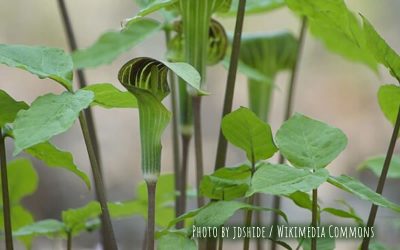
Jack-in-the-Pulpit
Arisaema triphyllum
Growing Information
• Plant Type: Perennial
• Sunlight: Part Shade to Shade
• Soils: Moist to Wet
• Bloom Time: Unique green flowers in spring
• Size: 1-2 feet in height and 1-2 foot spread
This spring-blooming perennial is known for its unique flower that resembles a pitcher. After flowering, the modified leaves surrounding the ovary fall off, revealing a cluster of fruit that begin as a green color and turn red as they ripen. This plant makes a great specimen species for moist, shady woodland gardens. Wear gloves when transplanting this specimen, as the roots can cause blisters on sensitive skin.
Garden Companions
Foam Flower (Tiarella cordifolia), Christmas Fern (Polystichum acrostichoides)
Nature Benefits
• The fruit provides food for birds and mammals
• Early flowering time provides a nectar source for early season pollinators.
Native Habitat
Forests, marshes, floodplains, and the shores of streams and ponds.
Photos
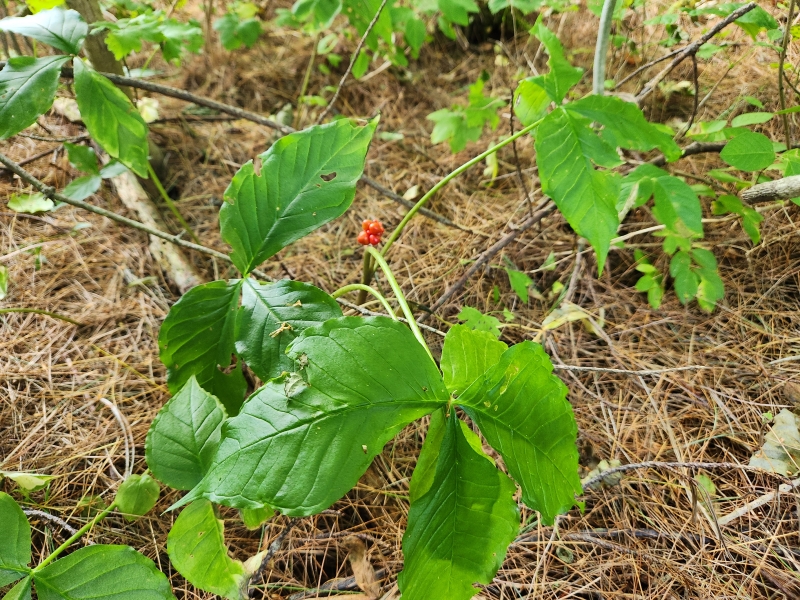

Blue Flag Iris
Iris versicolor
Growing Information
• Plant Type: Perennial
• Sunlight: Sun to Part Shade
• Soils: Moist to Wet
• Bloom Time: Showy purple flowers in May, June, July
• Size: 1-3 feet in height and 1-2 foot spread
Also called, northern blue iris, this native will do best in garden soils with organics for moisture retention. Wear gloves and handle with care when transplanting, as the roots can cause minor skin irritation. Spreads both by self-seeding and extensions of rhizomes.
Garden Companions
Red Cardinal Flower (Lobelia cardinalis), Buttonbush (Cephalanthus occidentalis)
Nature Benefits
• Flowers attract a variety of butterflies and hummingbirds
Native Habitat
Marshes, wet meadows, shores of streams and ponds.

Speckled Alder
Alnus incana
Growing Information
• Plant Type: Tree
• Sunlight: Sun to Shade
• Soils: Moist to Wet
• Bloom Time: Small red catkins in early spring
• Size: 15-25 feet in height and 5-10 foot spread
Speckled alder is a common plant of abandoned cranberry bogs and other low, wet areas around the Cape. It grows quickly and has the ability to form dense thickets that stabilize soil and prevent erosion. This plant is best identified by its unique fruit structure that is a cone-like cluster filled with small winged nutlets. Old cones typically persist for a year after forming, so they can be seen in all seasons.
Garden Companions
New York Ironweed (Vernonia novaboracensis), Red Cardinal Flower (Lobelia cardinalis)
Nature Benefits
• Nutlets provide food for many songbirds.
• Commonly used by beavers to build dams and lodges.
• Thickets provide cover for wildlife.
Native Habitat
Marshes and bogs, shores of rivers or lakes.
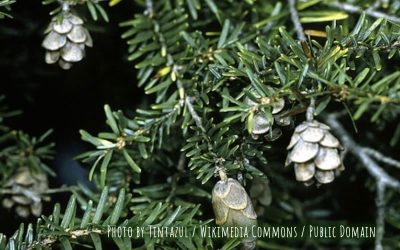
Eastern Hemlock
Tsuga canadensis
Growing Information
• Plant Type: Tree
• Sunlight: Part Shade to Shade
• Soils: Average to Moist
• Bloom Time: Non-showy yellow flowers in spring
• Size: 80-100 feet in height and 10-20 foot spread
One of the most shade tolerant trees of New England, the eastern hemlock is perfectly happy to grow in the shade cast by even a dense woodland. However, it does require richer soil, and is less tolerant of nutrient-poor, sandy soils, especially in full sunlight. This is a great tree for hedges, as hemlocks retain their lower branches, unlike other pitch pine (Pinus rigida) and white pine (Pinus strobus), offering a full screen throughout all seasons.
Garden Companions
Foam Flower (Tiarella cordifolia), Christmas Fern (Polystichum acrostichoides)
Nature Benefits
• Provides dense winter cover for wildlife
• Larval host to the Columbia silkmoth (Hyalophora columbia)
Native Habitat
Forests, rocky slopes, wetland margins.

Slender Blue Iris
Iris prismatica
Growing Information
• Plant Type: Perennial
• Sunlight: Part Shade
• Soils: Moist to Wet
• Bloom Time: Showy purple flowers in late spring
• Size: 1-2 feet in height and 1-2 foot spread
A native species of the popular Iris genus, slender blue iris naturally grows along tidal marshes on the Cape. Its showy flowers are a great addition to wetter spots. Wear gloves and handle with care when transplanting, as the roots can cause minor skin irritation when touched.
Garden Companions
Red Cardinal Flower (Lobelia cardinalis), Buttonbush (Cephalanthus occidentalis)
Nature Benefits
• Flowers attract a variety of pollinators
Native Habitat
Tidal marshes, wet meadows, shores of streams and ponds.
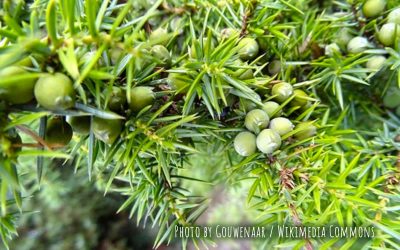
Common Juniper
Juniperus communis
Growing Information
• Plant Type: Shrub
• Sunlight: Sun
• Soils: Dry
• Bloom Time: Non-showy yellow flowers in spring
• Size: 3-5 feet in height and 5-8 foot spread
This low-growing shrub is able to grow in a variety of conditions, having the widest worldwide native range of any conifer. Although it may become a small tree in other parts of the world, on the Cape it is commonly seen as a small, creeping shrub. The juniper “berries” that this plant features, known for flavoring gin and as a common seasoning, are actually seed cones, resembling a tiny version of a typical conifer cone.
Garden Companions
Pennsylvania Sedge (Carex pensylvanica), New Jersey Tea (Ceanothus americanus)
Nature Benefits
• Provides dense winter cover for birds and small mammals
• Cones act as a food source for a variety of birds
Native Habitat
Cliffs and ledges, dry fields, and rocky slopes.
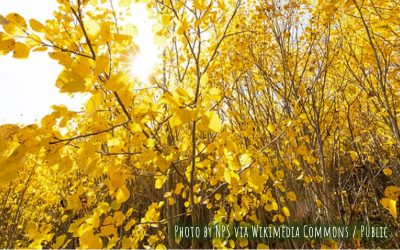
Quaking Aspen
Populus tremuloides
Growing Information
• Plant Type: Tree
• Sunlight: Sun to part shade
• Soils: Dry to Moist
• Bloom Time: Small catkins in spring
• Size: 40-80 feet in height and 10-20 foot spread
Quaking aspen has many stunning ornamental features, such as bright yellow/golden fall foliage, and distinctive white bark with grayish black “eyes.” Like other aspens, the leaves rustle wildly in the wind. This is because the leaves of aspen trees feature a flattened petiole, the stem that attaches leaves to twigs. This petiole allows the leaf to flex more easily with the wind, preventing wind damage during intense storms.
Garden Companions
Teaberry (Gaultheria procumbens), Golden Groundsel (Packera aurea)
Nature Benefits
• Larval host to the great ash sphinx moth (Sphinx chersis), eastern tiger swallowtail butterfly (Papilio glaucus) and viceroy butterfly (Limenitis archippus).
Native Habitat
Forest edges, shrublands and thickets.
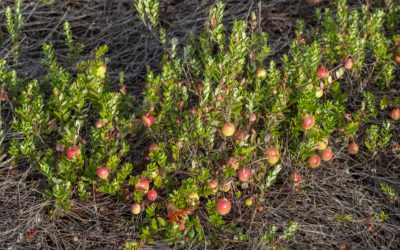
American Cranberry
Vaccinium macrocarpon
Growing Information
• Plant Type: Perennial
• Sunlight: Sun to part shade
• Soils: Acidic, nutrient poor, well-draining soil
• Bloom Time: Small pink or white flowers in May and June
• Size: 1-2 feet in height and spread
The signature cranberry bogs of Cape Cod are populated with cultivars of this species. Native to much of the Northeast, and prevalent on the Cape, the American cranberry is perfectly adapted to our sandy soils. While this plant is traditionally seen in agricultural bogs, it actually prefers well-draining sand that is wet occasionally. Cranberry bogs are flooded for easier harvesting, protection against cold weather, and weed control, but not for plant health.
Garden Companions
Lowbush Blueberry (Vaccinium angustifolium), Sheep Laurel (Kalmia angustifolia)
Nature Benefits
• Berries provide food for a variety of wildlife.
• Supports specialized bees that need the Vaccinium genus
• Flowers provide nectar to a variety of pollinators.
Native Habitat
Edges of marshes and bogs, shores of rivers or lakes.
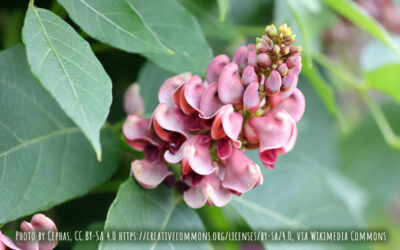
American Groundnut
Apios americana
Growing Information
• Plant Type: Vine
• Sunlight: Part sun to Shade
• Soils: Moist to Wet
• Bloom Time: August to September
• Size: 2-4 feet in height; up to 15 foot spread
This native vine grows in moist shade, typically on wetland margins. The roots feature edible tubers that have been used for stews or fried for hundreds of years. The inflorescence (cluster of flowers) also features tiny nectaries that provide food for ants.
Garden Companions
Turtlehead (Chelone glabra), New York Ironweed (Vernonia novaboracensis)
Nature Benefits
• Fragrant flowers and edible tubers.
• Host plant to the Silver-spotted Skipper butterfly (Epargyreus clarus)
Natural Habitat
Occurs in marshes and wetland margins, shores of rivers and ponds.

Red Cardinal Flower
Lobelia cardinalis
Growing Information
• Plant Type: Perennial
• Sunlight: Sun to part shade
• Soils: Rich medium-wet soil
• Bloom Time: Red flowers in late summer/early fall
• Size: 24-36 inches tall; 8-12 inch spread
Lobelia cardinalis is an eye-catching plant with bright red, bell-shaped flowers. They love to grow close to water and are good for rain gardens or plantings with wet soil. They are also unappealing to deer and rabbits as the plant contains toxins. The Cherokee used the leaves medicinally to help treat headaches, colds, and fevers. Individual plants are short-lived, but in the right place, cardinal flower will self-seed and send out offshoots to colonize an area.
Garden Companions
Buttonbush (Cephalanthus occidentalis), Great Blue Lobelia (Lobelia Siphilitica), Turtlehead (Chelone glabra), Rose/Swamp Milkweed (Asclepias incarnata)
Nature Benefits
• Attracts pollinators, bees, butterflies, and hummingbirds
Natural Habitat
Naturally found around swamps, along stream shores, and in marshes

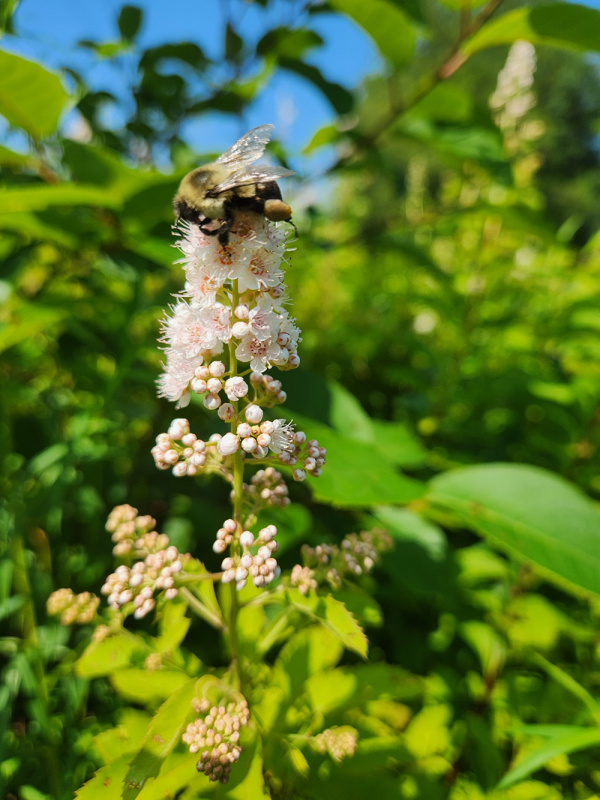
Meadowsweet
Spirea alba
Growing Information
• Plant Type: Shrub
• Sunlight: Prefers full sun but tolerates part shade
• Soils: Likes moist soil but can withstand occasional wet or dry soil
• Bloom Time: White to pink flowers bloom late June-early August
• Size: 3-4 feet tall and wide
Spirea alba is a deciduous shrub in the rose family that grows in a dense, mounding form. It features cone-shaped spires of small flowers in mid-summer, and the leaves showcase beautiful golden-yellow color during the fall. Unappealing to deer and rabbits.
Garden Companions
Rose/Swamp Milkweed (Asclepias incarnata), Green and Gold (Chrysogonum virginianum), New York Ironweed (Vernonia novaboracensis), Common Sneezeweed (Helenium autumnale)
Nature Benefits
• Host for the larvae of the Spring Azure butterfly
• Attracts bees, moth, butterflies, and other pollinating insects
• Attracts songbirds
Natural Habitat
Naturally found in bogs, swamps, wet meadow, and along shores or stream banks
Photos
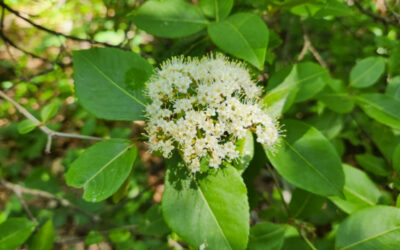
Wild Raisin / Witherod
Viburnum nudum
Growing Information
• Plant Type: Shrub
• Sunlight: Sun to part shade
• Soils: Average, moist
• Bloom Time: White flowers in May-June
• Size: 5-10 feet in height; 5-8 foot spread
Viburnum nudum is a low maintenance, multi-stemmed shrub that produces showy, white flower clusters. It doesn’t love dry soil but is highly adaptable and can survive brief periods of drought. It is a good choice for massing, creating a hedge, or as a specimen plant. It produces colorful, edible berries that can be anywhere from green to red to deep blue/black. Mildly resistant to deer.
Garden Companions
Buttonbush (Cephalanthus occidentalis), Highbush Blueberry (Vaccinium corymbosum), Lowbush Blueberry (Vaccinium angustifolium), Mountain Laurel (Kalmia latifolia), Rose/Swamp Milkweed (Asclepias incarnata), Wintergreen (Gaultheria procumbens)
Nature Benefits
• Berries attract birds and feed mammals
• Flowers attract bees
Natural Habitat
Naturally found in bogs, low woods, fields, swamps, marshes, and along streams or ponds
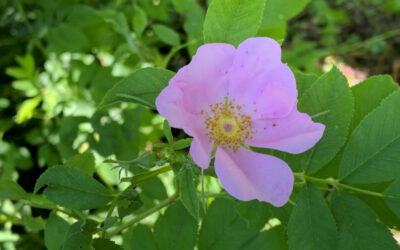
Swamp Rose
Rosa palustris
Growing Information
• Plant Type: Shrub
• Sunlight: Sun to part shade
• Soils: Medium-wet soil, good drainage
• Bloom Time: Fragrant pink flowers June-July
• Size: 3-6 feet tall and wide
Rosa palustris is a deciduous, multi-stemmed shrub that grows upright with arching branches. It spreads through suckers forming a dense structure that provides great cover for wildlife. In the fall its leaves turn a nice shade of red. It also produces small, reddish-orange hips that are eaten and spread by birds and other wildlife.
Garden Companions
Buttonbush (Cephalanthus occidentalis), Marsh Marigold (Caltha palustris), Turtlehead (Chelone glabra), Rose/Swamp Milkweed (Asclepias incarnata), Great Blue Lobelia (Lobelia siphilitica)
Nature Benefits
• Flowers attract bees, butterflies, and other pollinators
• Rose hips provide food for birds and wildlife
Natural Habitat
Naturally found around swamps, along stream shores, and in marshes.
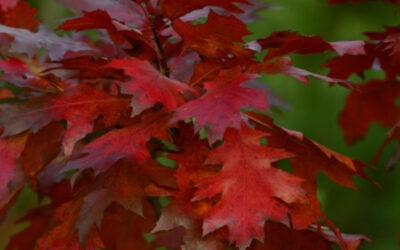
Northern Red Oak
Quercus rubra
Growing Information
• Plant Type: Tree
• Sunlight: Sun to part shade
• Soils: Average, moist, occasionally dry
• Bloom Time: Inconspicuous green/gold flowers in spring
• Size: 60-80 feet in height; 30-45 foot spread
Quercus rubra is a fast growing, deciduous tree with fantastic fall foliage. The pointed lobed leaves and reddish-brown to dark gray bark help distinguish it from white oaks. It’s tolerant of a variety of challenging conditions, including drought and salt spray. Red oak also supports a rich diversity of insects that rely on it for food and habitat. In general, oaks are a keystone species that support upland ecosystems.
Garden Companions
Bearberry (Arctostaphylos uva-ursi), Pennsylvania Sedge (Carex pensylvanica), Golden Groundsel (Packera aurea)
Nature Benefits
• Pollinator powerhouse
• Attracts songbirds
• Attracts a variety of insects
• Supports small mammals
Natural Habitat
Forests, woodlands

American Beech
Fagus grandifolia
Growing Information
• Plant Type: Tree
• Sunlight: Sun to part shade
• Soils: Average
• Bloom Time: Inconspicuous green/gold flowers in spring
• Size: 50-70 feet in height; 25-50 foot spread
Fagus grandifolia is a slow-growing tree known for its smooth, light-gray bark. It’s somewhat salt tolerant and fairly deer and rabbit resistant. It’s not uncommon for a beech tree to be surrounded by saplings as it suckers readily. Its deciduous leaves turn golden brown in autumn but persist throughout the winter. Unfortunately, beech trees are highly susceptible to beech leaf disease that has been rapidly spreading throughout New England and can cause the tree to die.
Garden Companions
Sugar maple (Acer saccharum), Yellow birch (Betula alleghaniensis)
Nature Benefits
• Pollinator powerhouse
• Food source for birds and other wildlife
Natural Habitat
Upland woods
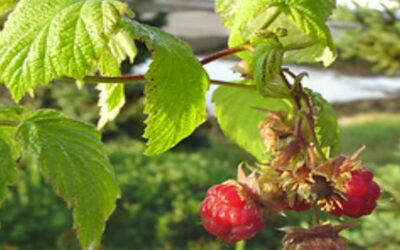
Common Red Raspberry
Rubus idaeus
Growing Information
• Plant Type: Shrub
• Sunlight: Sun to part shade
• Soils: Dry, well-draining
• Bloom Time: April-May
• Size: 3-4 feet in height; 5-9 feet spread
The plant has a wide native range and is prevalent throughout New England. It is an extraordinarily successful early successional plant and is one of the first to appear after major disturbances. The berries are edible and extremely attractive to both humans and wildlife. The flowers require insect pollination from bees, hummingbirds, butterflies, etc. for the fruits to appear. This raspberry is partial to the Cape’s drier, fast draining soil.
Garden Companions
Nodding Onions (Allium cernuum), Blue Vervain (Verbena hastata), Wild Bergamot (Monarda fistulosa)
Nature Benefits
• Fruit attracts birds and small mammals
• Flowers attract pollinators
Natural Habitat
Wetland edges, forest edges, fields, lake, and pond shorelines. It is an early successional plant and favors areas prone to disruption.

Flowering Dogwood
Benthamidia florida (formerly Cornus florida)
Growing Information
• Plant Type: Tree
• Sunlight: Sun to part shade
• Soils: Grows best in rich/acidic/well drained soil. Also does fine in average or clay soils.
• Bloom Time: White flowers in May
• Size: 15-20 feet in height, 5-8 feet spread
This smaller tree has a short trunk and a spreading crown of nearly horizontal branches. It blooms with beautiful 4-petaled flowers in May and is a popular addition to many gardens. It displays red to purple fall foliage and develops berries in October that are edible to wildlife. Indigenous Americans used the aromatic bark and roots as a remedy for malaria, and red dye could also be extracted from the roots.
Garden Companions
Wild Geranium (Geranium maculatum), Mountain Laurel (Kalmia latifolia), Blue Wood Aster (Symphyotrichum cordifolium)
Nature Benefits
• Seeds and berries provide food for birds.
• Supports over 100 species of butterflies and moths throughout their life cycle.
• Sprouts and seeds support a variety of mammals.
• Provides shelter and habitat for many wildlife species.
Natural Habitat
Occurs in forests, forest edges, and woodlands.
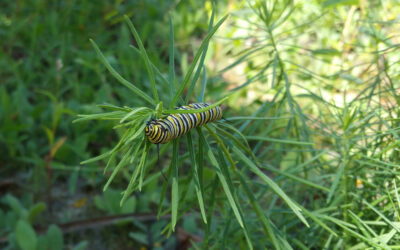
Whorled Milkweed
Asclepias verticillata
Growing Information
• Plant Type: Perennial
• Sunlight: Full Sun to Partial
• Soils: medium to dry
• Bloom Time: July, August
• Size: 1-2 feet in height
A Cape Cod native, but rare in Massachusetts. Drought-tolerant. Leaves are narrow, needle like. It serves as a host plant for monarch caterpillars. Flowers are fragrant. Good for a low meadow setting or container planting. Like all milkweeds, produces pods with many seeds. May not flower until second year of growth.
Garden Companions
Butterfly Milkweed (Asclepias tuberosa), Black-eyed Susan (Rudbeckia fulgida), Purple Coneflower (Echinacea purpurea)
Nature Benefits
• Attracts monarch butterflies to lay their eggs.
• Flowers attract other pollinators.
Natural Habitat
Occurs in fields, pastures, and roadsides.
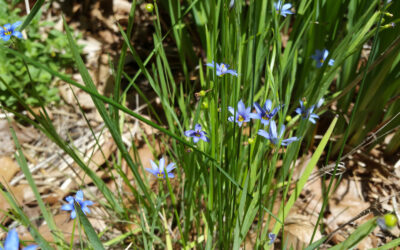
Blue-eyed Grass
Sisyrinchium angustifolium
Growing Information
• Plant Type: Perennial
• Sunlight: Full Sun to Partial
• Soils: medium
• Bloom Time: May-June
• Size: 8-10 inches in height
A Cape Cod native! Prefers well-drained soils in full sun or part shade, and drought tolerant once established. A short-lived perennial should be divided every 2-3 years to promote vigor and increase life span. Avoid thick mulch layer that will cause crown rot. Will reseed, but if reseeding is not desirable, sheer/deadhead to remove developing seed capsules. The flowers open with the warmth of the sun. Best used as a border front, in rock gardens, to line pathways, at the woodland’s edge or groundcover. Somewhat unpalatable to rabbits.
Garden Companions
Smooth Aster (Aster laevis), Beardtongue (Penstemon digitalis), Anise-scented Goldenrod (Solidago odora)
Nature Benefits
• Attracts bumble bees, sweat bees, and other pollinators.
• Seeds are valuable to small mammals and birds.
Natural Habitat
Occurs in fields and wetland edges.
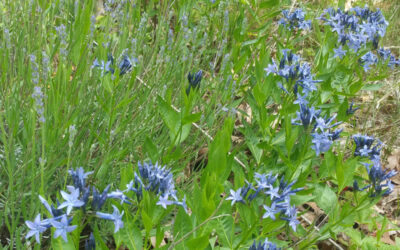
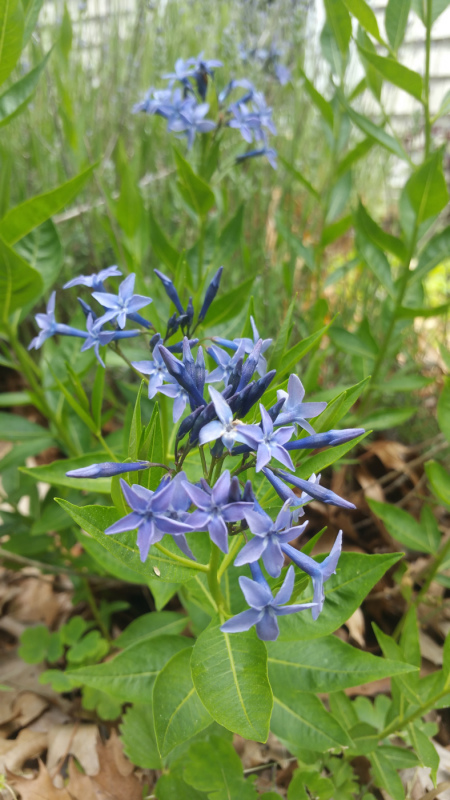
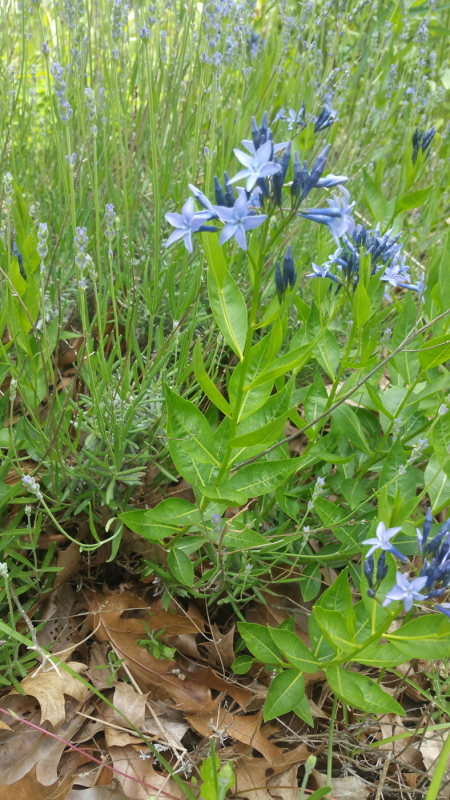
Eastern Bluestar
Amsonia tabernaemontana
Growing Information
• Plant Type: Perennial
• Sunlight: Full Sun to Partial
• Soils: sandy, clay, loamy
• Bloom Time: Blue flowers in May-June
• Size: 2-3ft tall with 2-3ft spread
Native to southern states and according to GoBotany.NativePlantTrust.org it is found in New England due to garden introduction. A good choice for containers, butterfly gardens, rain garden or naturalized garden. Prefers moist garden conditions, however once established it is drought tolerant. Slow grower, low care. Unpalatable to deer.
Garden Companions
Purple coneflower (Echinacea purpurea), False Indigo (Baptisia australis), Beardtongue (Penstemon digitalis)
Nature Benefits
• Attracts hummingbirds, carpenter bees, hummingbird moths, and butterflies like mourning cloak.
• Larval host for coral hairstreak butterfly.
Natural Habitat
Naturally occurs meadows, fields, shores of rivers or lakes.
Photos
Silverrod / White Goldenrod
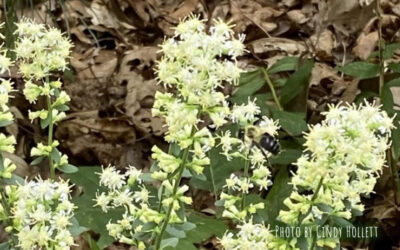
Solidago bicolor
Growing Information
• Plant Type: Perennial
• Sunlight: Full to partial sun
• Soils: poor, sandy, clay; dry to average moisture
• Bloom Time: White to yellowish flowers July through October
• Size: 1-3 feet tall; 1ft spread
This is an east coast native that is extremely drought and salt tolerant. Sap is distasteful to deer and rabbits. Like all goldenrods, it does not contribute to hayfever and is extremely important to supporting local food webs.
Garden Companions
Little bluestem grass (Schizachyrium scoparium); Yellow Wild Indigo (Baptisia tinctoria); Blue Wood Aster (Symphyotrichum cordifolium)
Nature Benefits
• Attracts a wide variety of pollinators, including specialized bees.
• Host plant for caterpillars of brown-hooded owlet, wavy-lined emerald, and others.
• Seeds are eaten by songbirds.
Natural Habitat
Open woodlands.
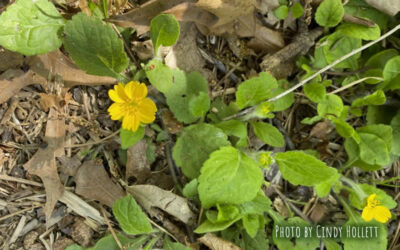
Green and Gold
Chrysogonum virginianum
Growing Information
• Plant Type: Perennial
• Sunlight: Partial to full shade
• Soils: moist, well-drained
• Bloom Time: Yellow flowers mostly in spring, with sporadic flowers into September
• Size: 6 inches, spread 24 inches
Low growing semi-evergreen groundcover. Drought tolerant and good for naturalizing. Native to Pennsylvania and states south. Plant is susceptible to mildew in situations with poor drainage and too much mulch limiting air flow around the leaves. Resistant to fire. Early spring flowers support pollinators. Plant along woodland edges, walkways, rock gardens.
Garden Companions
Dwarf Iris (Iris cristata), Foam Flower (Tiarella spp), Eastern Wood Fern (Dryopteris marginalis)
Nature Benefits
• Attracts wide variety of pollinators looking for early season nectar.
• Seeds are eaten by songbirds.
Natural Habitat
Naturally occurs in woodlands.
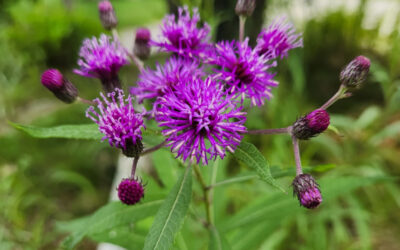
New York Ironweed
Vernonia novaboracensis
Growing Information
• Plant Type: Perennial
• Sunlight: Full sun to part shade
• Soils: Medium moisture
• Bloom Time: Purple flowers late August through September
• Size: 4-6 foot in height
A tall, coarse, and upright plant that creates beautiful deep purple flowers that turn into rusty seed clusters. This plant is great for bordering backyard garden areas and wildflower gardens. Needs consistent moisture to be happy but will tolerate short periods of dryness. Native to Barnstable County.
Garden Companions
Goldenrod (Solidago spp); White Wood Aster (Eurybia divaricatus)
Nature Benefits
• Important nectar source for many species of bees, butterflies, skippers, and moths.
• Seedheads are eaten by birds.
Natural Habitat
Occurs naturally in thickets along streams, pondshores, fields and meadows.
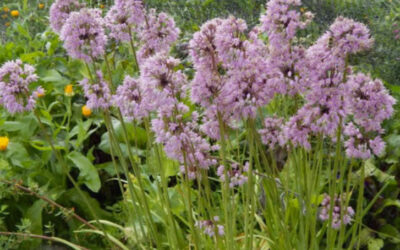
Nodding Onion
Allium cernuum
Growing Information
• Plant Type: Perennial
• Sunlight: Full to part sun
• Soils: prefers moist, circumneutral pH soils, but is tough and adaptable to drier spots.
• Bloom Time: June-September
• Size: Up to 2 feet tall when flowering.
Pompom-shaped, purple flowers appear on the plant throughout the summer. Seed head begins to droop as it matures, hence the name “nodding” onion. Not as edible as other Allium sp., so best saved for the bees! Can self-seed in ideal conditions and benefits from being divided after a few years. Other native Alliums such as Allium canadense (Wild Garlic) and Allium schoenoprasum (Wild Chives) are a bit tougher, but less showy. Not a Cape Cod native, but native to Long Island and states to the west and south.
Garden Companions
Purple Lovegrass (Eragrostis spectabilis), Butterflyweed (Asclepias tuberosa), Anise Hyssop (Agastache foeniculum), Asters (Symphyotrichum spp.)
Nature Benefits
• Highly attractive to butterflies, bees, and hummingbirds
Natural Habitat
Dry to moist prairies, stream banks, open woodlands.
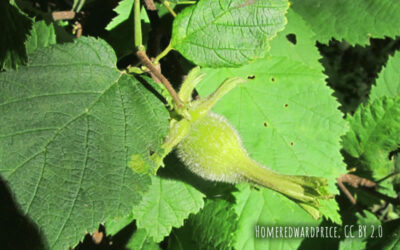
Beaked Hazelnut
Corylus cornuta
Growing Information
• Plant Type: Shrub
• Sunlight: Full, partial
• Soils: Medium-dry to Moist, well-drained
• Bloom Time: February, March
• Size: 3-8ft tall
A true Cape Cod native shrub. Foliage turns bright yellow in fall. Male catkins appear before the leaves. Flowers are inconspicuous pinky-purple and are wind pollinated. The nuts are enclosed in a husk that extends beyond the nut to form the “beak.” Nuts are a favorite of wildlife. Its long catkins are a welcome sight in the garden in late winter. It is an attractive shrub in a woodland garden.
Garden Companions
Serviceberry (Amelanchier canadensis); Padoga Dogwood (Cornus alterniflora); Ninebark (Physocarpus opulifolius)
Nature Benefits
• Nuts are favorite of wildlife
Natural Habitat
Forests, and forest edges.
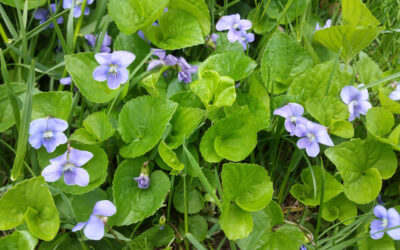
Common Blue Violet
Viola sororia
Growing Information
• Plant Type: Perennial
• Sunlight: Part shade or light, filtered shade. Tolerates full sun in wetter soil.
• Soils: Average to moist, well drained soils
• Bloom Time: April, May, June
• Size: 4-10 inches high
A wonderful and easy to grow wildflower which readily self-seeds. Excellent for planting in masses under deciduous trees, on the borders of flower beds, or filling a shaded, low-traffic area of a lawn. Better to have many growing because their greens are food source for small mammals, turkeys, quail, and caterpillars. Also edible for humans! More information on the many other native species in the genus viola, and their habitats, can be found on https://gobotany.nativeplanttrust.org/
Garden Companions
Wild Columbine (Aquilegia canadensis); Pennsylvania Sedge (Carex pensylvanica), Heartleaf Aster (Symphyotrichum cordifolium), Canada Anemone (Anemonastrum canadense)
Nature Benefits
• Provides nectar and nesting material for native bees.
• Leaves and seeds are eaten by small mammals, turkey, bobwhite quail, and grouse.
• Larval host for the Great Spangled Fritillary (Speyeria cybele)
Natural Habitat
Moist-average woodlands, woodland edges. Other viola species can be found in drier or wetter areas.
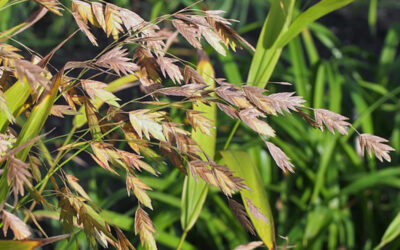
Northern Sea Oats
Chasmanthium latifolium
Growing Information
• Plant Type: Grass
• Sunlight: Part shade to shade. Tolerates more sun in wetter soils but prefers shade.
• Soils: Tolerates a wide range of soils.
• Bloom Time: July-September. Seed heads appear in the fall and persist into winter.
• Size: 30-48 inches tall
One of our most beautiful and adaptable ornamental grasses for fall and winter interest, and the only one with considerable shade tolerance. Will readily spread in richer, moist soils, but sticks to upright clumps in dry soils. Elegant drooping seed heads are a food source for birds and woodland mammals. Deer resistant, heat tolerant, and easy to divide and transplant.
Garden Companions
White Turtlehead (Chelone glabra); Black-eyed Susan (Rudbeckia hirta); Blue Lobelia (Lobelia siphilitica); Appalachian False Goat’s Beard (Astilbe biternata)
Nature Benefits
• Seedheads are late season food for small mammals and granivorous birds.
• Larval host for several species of skipper butterfly (family Hesperiidae)
Natural Habitat
Riverbanks, floodplains, moist woodland slopes and edges.
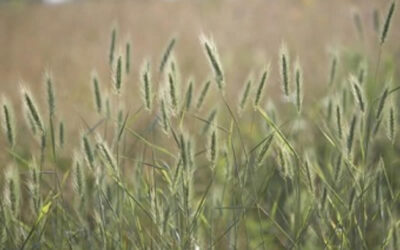
Virginia Wild Rye
Elymus virginicus
Growing Information
• Plant Type: Grass
• Sunlight: Sun to part shade
• Soils: Prefers heavy, rich, moist soils but will tolerate average sandy soils in shadier spots
• Bloom Time: March, April, May. Seed drops end of spring/early summer
• Size: Up to 4ft
A true problem solver! Mix with an aggressive warm season spreader like Prairie Cordgrass (Spartina pectinata) for a seed mix that can quickly reclaim eroded landscapes and out-compete problematic invasives like Japanese Knotweed (alongside cutting and hand-pulling first resprouts). Great for re-establishing native vegetation after intensive invasive species control or construction on moist slopes. Provides cover and food for wildlife.
Garden Companions
Prairie Cordgrass (Spartina pectinata), Northern Sea Oats (Chasmanthium latifolium), Black-eyed Susan (Rudbeckia hirta), Scarlet Beebalm (Mondarda didyma), Mountain Mints (Pycnathemum sp.)
Nature Benefits
• Rapid groundcover for protecting exposed soil from invasive weeds.
• Provides food for waterfowl and granivorous birds.
• Provides cover for frogs, small mammals, and birds.
Natural Habitat
Riverbanks, moist slopes and woodland edges, pasture.
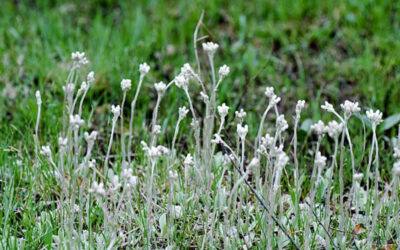
Field Pussytoes
Antennaria neglecta
Growing Information
• Plant Type: Perennial
• Sunlight: Full to part sun
• Soils: Dry-Average, sandy or gravelly soils. Needs lean soils with good drainage.
• Bloom Time: April, May, June
• Size: 4-10 inches high.
A cute, inconspicuous groundcover for neglected areas and forms dense colonies. Excellent for seeding into a dry, patchy lawn, planting on a roadside strip, or a rock garden. Small, white flower spikes bounce around in the breeze like little cat paws. Bees and butterflies will visit the flowers. Several other similar Antennaria sp. may also be found in native plant nurseries.
Garden Companions
Wild Columbine (Aquilegia canadensis); Wavy hairgrass (Deschampsia flexuosa); Purple Lovegrass (Eragrostis spectabilis); Prairie smoke (Geum triflorum); Bearberry (Arctostaphylosuva-ursi)
Nature Benefits
• Provides pollen and nectar for native bees and butterflies.
• Larval host for the American Lady butterfly (Vanessa virginiensis)
Natural Habitat
Dry, open areas; roadsides, graveyards, old fields
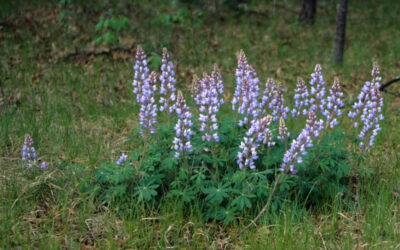
Wild Sundial Lupine
Lupinus perennis
Growing Information
• Plant Type: Perennial
• Sunlight: Sun to part shade.
• Soils: Dry to Moist, well drained soils. Prefers light, sandy or gravelly soil.
• Bloom Time: May-July
• Size: Up to 2ft tall in bloom
An excellent choice for barren areas as the plant prefers not to compete with other plants and is excellent at colonizing open space. Prefers not to be transplanted, so it is best grown from seed. Nitrogen fixer, drought tolerant once established. The beauty of its bloom is unrivaled in late spring. Establish a population on your property and brag about it to your neighbors. Attractive to hummingbirds and butterflies. BEWARE of non-native look-alikes in nurseries, they threaten to displace wild populations of this threatened plant, putting insects that depend on this species at risk of extinction.
Garden Companions
Black-eyed Susan (Rudbeckia hirta), Purple Lovegrass (Eragrostis pectinacea), Pitch Pine (Pinus rigida)
Nature Benefits
• Larval host to the critically endangered Karner Blue Butterfly (Plebejus samuelis)
• Attracts butterflies, hummingbirds and native bees.
Natural Habitat
Sand dunes, pine barrens, open woodlands and clearings, especially after a wildfire or landslide.
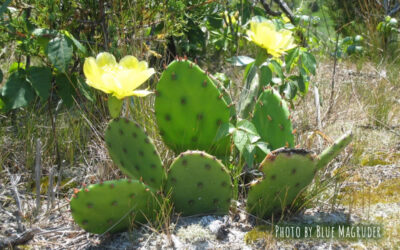
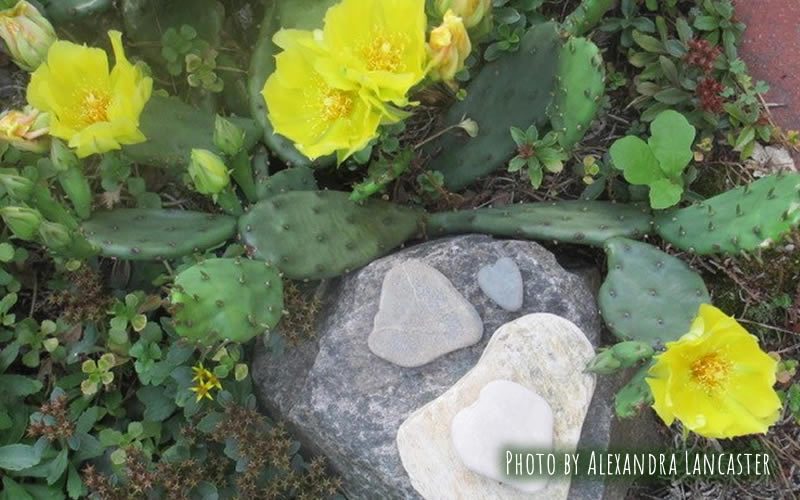
Eastern Prickly Pear
Opuntia humifusa
Growing Information
• Plant Type: Perennial
• Sunlight: Full sun
• Soils: Dry, sandy or rocky soil. Needs good drainage.
• Bloom Time: June-August. Fruit in mid-fall.
• Size: Up to 18 inches tall. Usually creeping.
New England’s only native cactus! Beautiful showy flowers and delicious, edible purple fruit make this plant a wonderful, unique specimen for rock gardens, roadsides, and barren sand/gravel strips. Great contrast with sparse grasses and herbs. Wild plants are protected in MA.
Garden Companions
Purple Lovegrass (Eragrostis spectibilis), Butterfly Milkweed (Asclepias tuberosa), Anise Hyssop (Agastache foeniculum), Bearberry (Arctostaphylos uva-ursi), Wavy Hairgrass (Deschampsia flexuosa)
Nature Benefits
• Fruit for birds, small mammals and people!
• Provides nectar and pollen for native bees.
Natural Habitat
Dry, sandy and rocky areas such as dunes and gravel fields.
Photo Gallery
Buttonbush
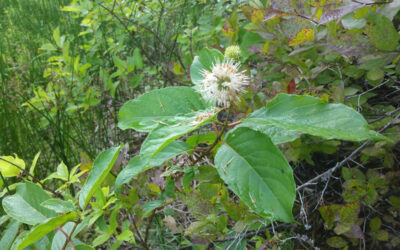
Cephalanthus occidentalis
Growing Information
• Plant Type: Shrub
• Sunlight: Full to part sun
• Soils: Moist to wet soils. Tolerates standing water
• Bloom Time: Mid-Summer
• Size: up to 12 ft
Showy, pom-pom like flowers attract tons of butterflies and hummingbirds. Loves water. Makes an attractive hedge or accent shrub at the edge of a pond or in a marshy area. Flowers mature into button-like fruits filled with seeds which attract ducks and other water birds.
Garden Companions
Winterberry (Ilex verticillata); Blue Flag Iris (Iris versicolor); Cardinal Flower (Lobelia cardinalis); Swamp Milkweed (Asclepias incarnata); Highbush Blueberry (Vaccinium corymbosum)
Nature Benefits
• Provides nectar for native bees, hummingbirds, and butterflies
• Seeds are eaten by ducks and other waterfowl
• Larval host to several species of sphinx moth
Natural Habitat
Marshes, wet meadows, bogs, and pond edges
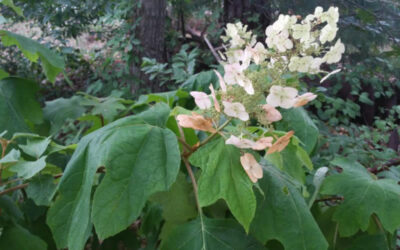
Oakleaf Hydrangea
Hydrangea quercifolia
Growing Information
• Plant Type: Shrub
• Sunlight: Full sun to part shade or filtered shade
• Soils: Moist, well-drained soils
• Bloom Time: May, June, July
• Size: 6-8 feet.
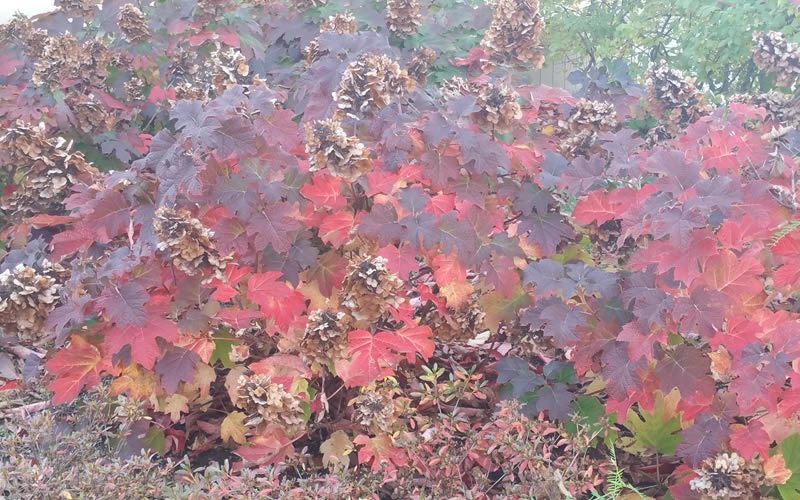
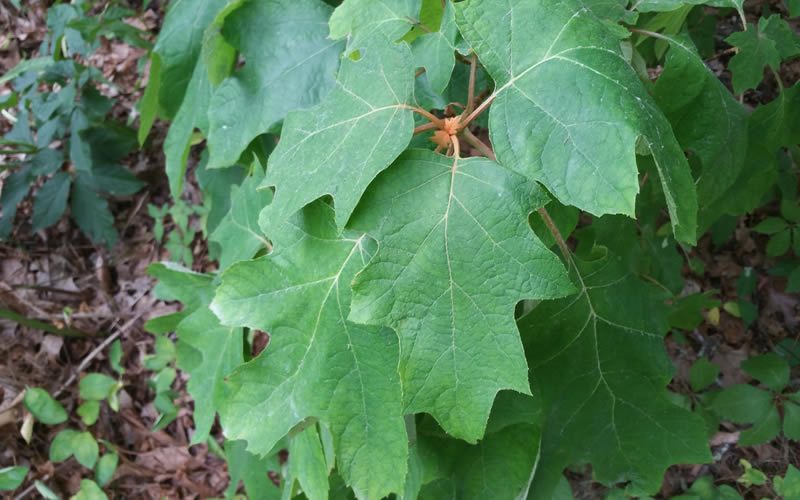
Perfect size, low maintenance shrub for an informal hedge or as a showy specimen. Shade tolerant. Finely divided leaves reminiscent of oaks, and large white flower spikes persist throughout the season. Fabulous fall color, and the peely bark and dry flowers provide winter interest as well. Great replacement for the ever-popular non-native hydrangeas. Native to southern states but does well in Massachusetts landscapes.
Garden Companions
Southern Magnolia (Magnolia grandiflora); Flame Azalea (Rhododendron calendulaceum); Eastern Redbud (Cercis canadensis); Dwarf Crested Iris (Iris cristata)
Nature Benefits
• Insects overwinter in spent stems.
• Nesting material for birds
Natural Habitat
Moist woods, riverbanks of southern states.
Photo Gallery
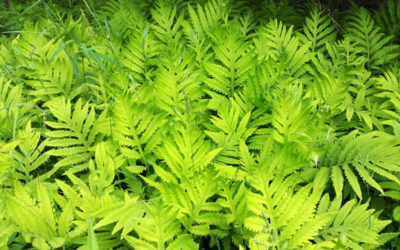
Sensitive Fern
Onoclea sensibilis
Growing Information
• Plant Type: Perennial
• Sunlight: Part shade. Tolerates full sun in wet soils.
• Soils: Moist to wet, acidic soils
• Bloom Time: N/A
• Size: Up to 3 feet tall
Distinctive, coarsely lobed fern that spreads by rhizomes in wet areas. Great as an underplanting for shrubs or as a filler in wet meadows. It is named sensitive fern because it quickly withers after the first frost. Bright lime green foliage, often with reddish undertones on fiddleheads and stems.
Garden Companions
Golden Alexander (Zizia aurea); Wild Geranium (Geranium maculatum); Swamp Milkweed (Asclepias incarnata); Marsh Marigold (Caltha palustris)
Nature Benefits
• Shelters salamanders and frogs
• Can spread aggressively, protecting soil from exotic invasive spreaders.
Natural Habitat
Moist woods, floodplains, streambanks, marshy ditches
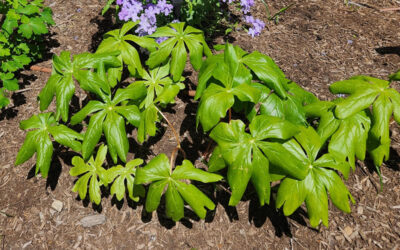
Mayapple / American Mandrake
Podophyllum peltatum
Growing Information
• Plant Type: Perennial
• Sunlight: Part Shade, Shade
• Soils: Average to Moist, acidic sandy loams.
• Bloom Time: April/May. Fruit in mid-summer.
• Size: 1-1.5ft tall. Spreads along the ground.
A unique woodland plant that grows very well in Cape Cod’s sandy deciduous forests. Interesting star-shaped foliage and spreading rhizomatic habit make this an excellent companion alongside native spring ephemerals. All parts of the plant are highly toxic to eat except the small yellow fruit, which has a lemony, candy-like flavor. Native to western MA.
Garden Companions
Deciduous trees – not pines! Woodland Phlox (Phlox divaricata), Bloodroot (Sanguinaria canadensis), Virginia Bluebells (Mertensia virginica), Golden Groundsel (Packera aurea)
Nature Benefits
• Fruit is eaten by box turtles and small mammals.
Natural Habitat
Mixed deciduous forest, shaded riverbanks and shaded fields.
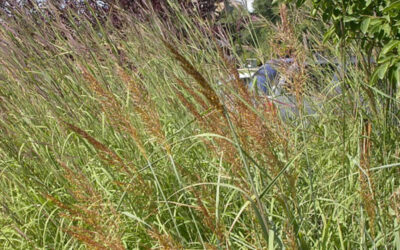
Indian Grass
Sorghastrum nutans
Growing Information
• Plant Type: Grass
• Sunlight: Full to part sun
• Soils: Dry to moist soils
• Bloom Time: August-October
• Size: Up to 8ft tall
A beautiful, tall ornamental grass with a bronze, metallic sheen to the seedheads. Blueish green foliage turns yellow as it begins to produce seeds in the fall. A crucial species in tallgrass prairies and is best utilized in naturalized masses. Great plant for screening.
Garden Companions
Joe-Pye Weeds (Eutrochium sp.); Evening Primrose (Oenothera biennis); New York Ironweed (Vernonia noveborecensis); Ox-Eye Sunflower (Heliopsis helianthoides)
Nature Benefits
• Provides nesting material and cover for birds and native bees.
• Seed heads provide late season food for birds.
Natural Habitat
Fields, rocky shorelines, woodland openings, and roadsides.
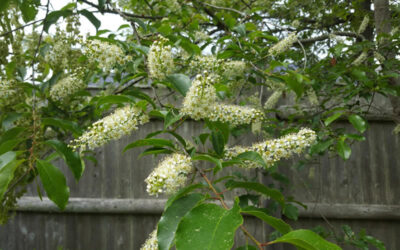
Virginia Bird-cherry / Chokecherry
Prunus virginiana
Growing Information
• Plant Type: Tree
• Sunlight: Full sun to partial shade.
• Soils: Dry-Moist. Prefers richer loams but is highly adaptable.
• Bloom Time: May-June. Fruits in late summer.
• Size: up to 30ft. Varies depending on light and soil conditions.
A large shrub or small deciduous tree with impressive adaptation to a wide variety of growing conditions. Can grow as a forest tree in moist shade or as a shrub on dry bluffs. Profuse cream- white flowers in late spring. Fruits are puckery sour but addictive and make a good July snack. Very attractive plant to birds and butterflies.
Garden Companions
Scrub Oak (Quercus ilicifolia); White Oak (Quercus alba); Pitch Pine (Pinus rigida); Sassafrass (Sassafras albidum); New Jersey Tea (Ceanothus americanus)
Nature Benefits
• Provides nectar for native bees and butterflies.
• Important food source for birds and mammals.
• Larval host to a huge variety of moths and butterflies such as hairstreaks and sphinx moths.
Natural Habitat
Moist woods, stream banks; prairie hillsides, fence rows, roadsides; sandy bluffs
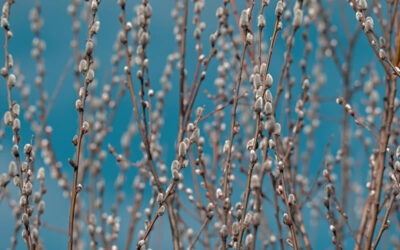
Pussy Willow
Salix discolor
Growing Information
• Plant Type: Shrub
• Sunlight: Full sun
• Soils: Moist to wet soils.
• Bloom Time: February, March
• Size: Up to 20ft tall, often shorter. Tolerates being cut back aggressively.
Fast growing shrub. Appreciates being cut back every few years to encourage vigorous new suckering growth. Fuzzy buds appear in late winter and open into sticky catkins which provide nectar and pollen during a crucial time of the year when food is scarce. Beautiful as an accent in cut flower arrangements. Propagates easily from cuttings. BEWARE of non-native hybrids in nurseries – they do not support native insects.
Garden Companions
American Blue-flag (Iris versicolor); Swamp Rosemallow (Hibiscus moscheutos); Marsh Marigold (Caltha palustris); Winterberry (Ilex verticillata)
Nature Benefits
• Provides nectar for native bees very early in the year when food is scarce.
• Larval host to many butterflies and moths, including the Morning Cloak (Nymphalis antiopa), Viceroy (Limenitis archippus), and the Cecropia Moth (Hyalophora cecropia).
• Birds feed on the buds and catkins; twigs are browsed by deer.
Natural Habitat
Marshy, low areas; streambanks and ditches.
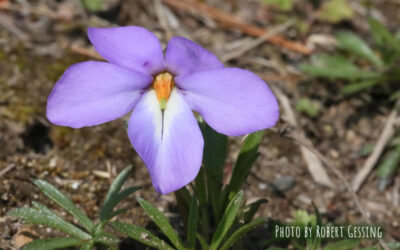
Bird’s Foot Violet
Viola pedata
Growing Information
• Plant Type: Perennial
• Sunlight: Full sun to partial, filtered shade
• Soils: Dry, acidic, sandy or gravelly soils. Needs good drainage.
• Bloom Time: April – June
• Size: 4-10 inches high
Beautiful lilac-colored flowers, larger than most violets – more like a pansy. A low, clumping perennial, easily identified by its finely divided bird’s foot-like leaves. Does well in poor upland soils, prefers not to compete with other plants. Great for rock gardens.
Garden Companions
Wild Columbine (Aquilegia canadensis); Wavy Hairgrass (Deschampsia flexuosa); Purple Lovegrass (Eragrostis spectabilis); New Jersey Tea (Ceanothus americanus); Lowbush Blueberry (Vaccinium angustifolium)
Nature Benefits
• Provides nectar for native bees and butterflies.
• Larval host for the Regal Fritillary (Speyeria idalia)
Natural Habitat
Rocky, open woods; sandy prairies and pine barrens
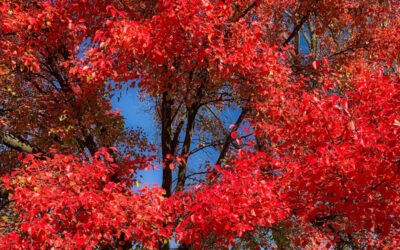
Tupelo/Black Gum
Nyssa sylvatica
Growing Information
• Plant Type: Tree
• Sunlight: Full sun, part sun
• Soils: Medium to wet soils.
• Bloom Time: Small green flowers from April-May, producing a sour black fruit in fall.
• Size: 20-50 feet in height.
Spectacular fall colors and pyramidal shape. Extremely high wildlife value, as the fruits are enjoyed by birds and small mammals and the flowers are important for early spring pollinators. The fruit is edible but quite sour. This tree is a favorite of European honeybees for nesting and honey production. Slow grower and can live over 600 years.
Garden Companions
Red Maple (Acer Rubrum); Great Rhododendron (Rhododendron maximum); Mountain Laurel (Kalmia latifolia); Canada Mayflower (Maianthemium canadense); Southern Magnolia (Magnolia Grandiflora); Native ferns
Nature Benefits
• Provides nectar for native bees.
• Attracts birds and small mammals with fruit in the fall.
• Hollows in the tree are very popular nesting sites for woodpeckers, owls, small mammals, and honeybees.
Natural Habitat
Moist deciduous forests and swamps. Occasionally tolerant of drier sites.
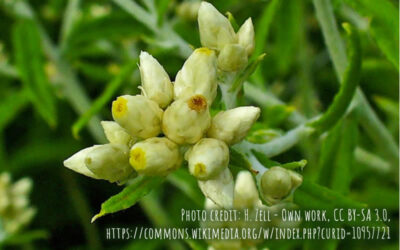
Rabbit Tobacco
Pseudognaphalium obtusifolium
Growing Information
• Plant Type: Annual
• Sunlight: Sun, part shade
• Soils: Medium to dry
• Bloom Time: White flowers in August, September, October too?
• Size: 1-3 feet in height
Also called sweet everlasting the leaves give off a maple syrup fragrance. Appropriate for butterfly and pollinator gardens. Widespread in the eastern half of the US it has cobwebby or wooly stems and small heads. Used medicinally for many ailments by native tribes.
Garden Companions
Butterfly Weed (Asclepias tuberosa), Spotted Bee Balm (Monarda punctata), Black-eyed Susan (Rudbeckia hirta), Culver’s Root (Veronicastrum virginicum), Golden Alexander (Zizia aurea)
Nature Benefits
• Larval host for the American Lady butterfly
• Flower nectar attracts bees, butterflies, wasps, and flies
Natural Habitat
Occurs in dry clearings, fields, and wood edges.
Photos
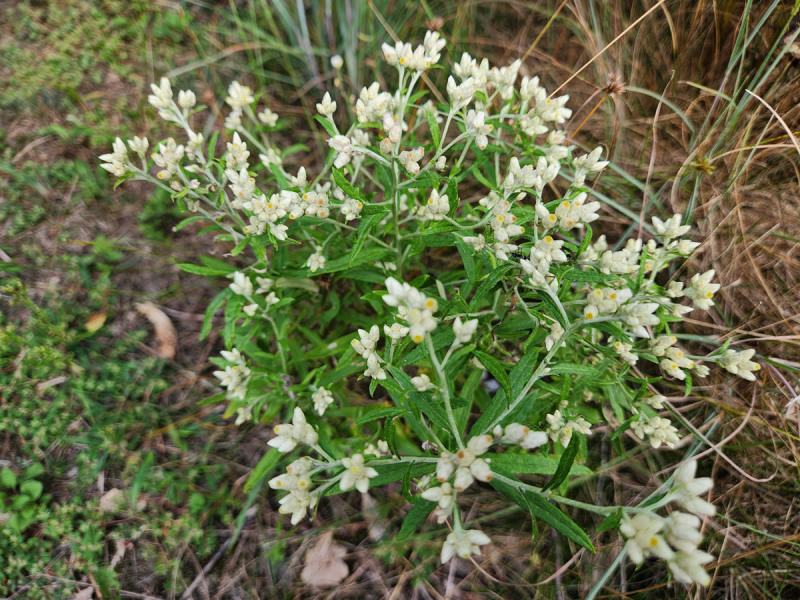
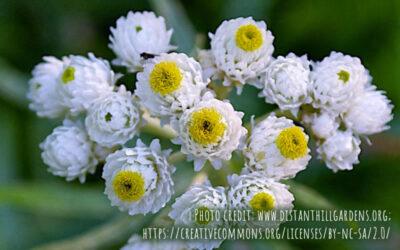
Pearly Everlasting
Anaphalis margaritacea
Growing Information
• Plant Type: Perennial
• Sunlight: Sun, part shade
• Soils: Poor sandy, dry or average
• Bloom Time: White flowers in July, August, September
• Size: 1-3 feet in height; 1-2 foot spread
Plant in rock gardens or to fill wide areas on slopes. It forms pearly mounds good for garden edges. Separate male and female flowers. Blossoms keep their color and shape well and are used in dried flower arrangements. Used by Native Americans as a substitute for tobacco and as a medicinal herb and in folk medicine as a salve for burns. Widely found and native to Cape Cod.
Garden Companions
Little Bluestem (Schizachyrium scoparium), Pussytoes (Antennaria plantaginifolia), Sweet Everlasting (Pseudognaphalium obtusifolium), Whorled Milkweed (Asclepias verticillata)
Nature Benefits
• Food plant for painted lady butterflies
• Larval host plant to the American Lady and Skipper butterflies
Natural Habitat
Occurs in disturbed areas, fields, shores of lakes.
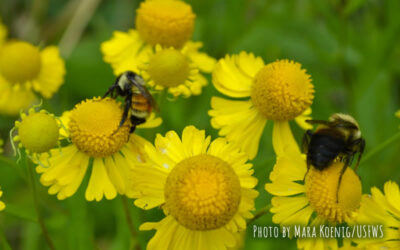
Common Sneezeweed
Helenium autumnale
Growing Information
• Plant Type: Perennial
• Sunlight: Sun, part shade
• Soils: Average, moist to wet
• Bloom Time: Yellow flowers in July, August, September
• Size: 1-3 feet in height; 2-3 foot spread
Plant this clump-forming perennial with daisy-like flowers in borders, meadows, and wild gardens. It blooms later in the summer when other blossoms have faded. Sneezeweed pollen does not cause allergies, but the leaves were crushed for snuff to induce sneezing for congestion or headaches. Not native on Cape Cod but is found in parts of New England.
Garden Companions
Rose Milkweed (Asclepias incarnata), Purple Coneflower (Echinacea purpurea), Joe Pye Weed (Eutrochium maculatum), Obedient Plant (Physostegia virginiana), New England Aster (Symphyotrichum novae-angliae), Great Blue Lobelia (Lobelia siphilitica)
Nature Benefits
• Attracts bees and other pollinators.
• Foliage is toxic and bitter, so mammalian herbivores don’t feed on it.
Natural Habitat
Occurs in meadows, shores of lakes, wetlands
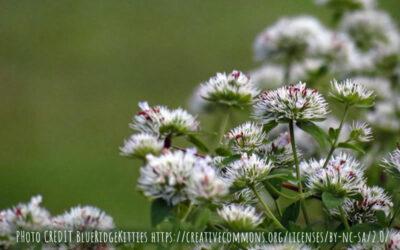
Appalachian Mountain Mint
Pycnanthemum flexuosum
Growing Information
• Plant Type: Perennial
• Sunlight: Sun, part shade
• Soils: Average, moist
• Bloom Time: White flowers in July, August
• Size: 2-3 feet in height; 1-3 foot spread
An aromatic, good soil stabilizer, it produces silvery white flowers above light green foliage. This species is not aggressive and will slowly expand. Plant in the border of a rain garden, pollinator, or native garden. Attracts throngs of desirable pollinators. Not a New England native but native to the southeast
Garden Companions
Black-eyed Susan (Rudbeckia hirta), Dense Blazing Star (Liatris spicata), Little Bluestem grass (Schizachyrium scoparium), Big Bluestem grass (Andropogon gerardii)
Nature Benefits
• Larval host for the Gray Hairstreak Butterfly and Wavy-lined Emerald
• Attracts bees, butterflies, moths, and wasps
Natural Habitat
Occurs in meadows, roadsides, open woodlands.
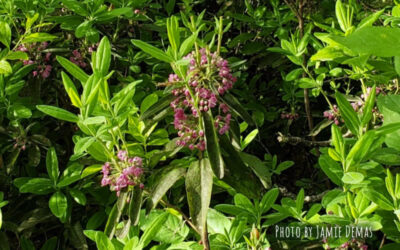
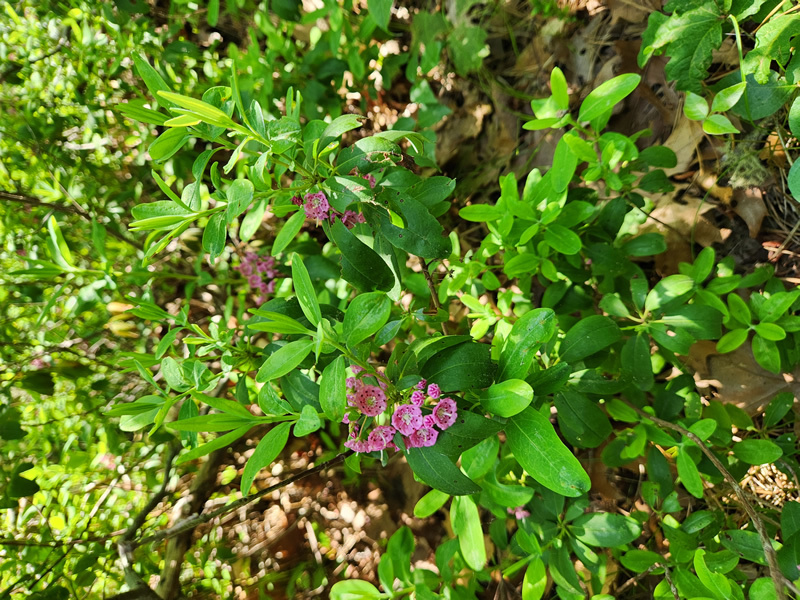
Sheep Laurel
Kalmia angustifolia
Growing Information
• Plant Type: Shrub
• Sunlight: Sun, part shade
• Soils: Average, dry or moist
• Bloom Time: Pink flowers in June, July
• Size: 1-3 feet in height; 1-3 foot spread
Adaptable to a variety of sites, plant in naturalized areas, foundation plantings, or woodland gardens. The showy Sheep Laurel is allelopathic, roots exude chemicals that inhibit conifer growth, it is also toxic to many mammals. It may form large evergreen colonies. The flowers are miniatures of Mountain Laurel. Native to Cape Cod.
Garden Companions
Christmas Fern (Polystichum acrostichoides), Wintergreen (Gaultheria procumbens), Sweet Fern (Comptonia peregrina)
Nature Benefits
• Provides winter forage and cover for birds
• Caterpillar host for the White Slant-line and the Mottled Gray Carpet moths
Natural Habitat
Found in forests, shores of ponds and lakes, bogs, and woodlands.
Photos
Selfheal
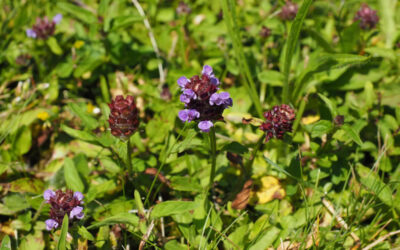
Prunella vulgaris
Growing Information
• Plant Type: Perennial
• Sunlight: Sun, part shade
• Soils: Moist, rich
• Bloom Time: Purple flowers in July, August
• Size: 6-12 inches in height
Selfheal is easy to grow under most conditions and can be aggressive. The common name comes from worldwide medicinal use of this plant. The leaves can be eaten cooked or raw. The plant commonly found in lawns is thought to be the Eurasian variety. Native to Cape Cod and the US.
Garden Companions
Butterfly Milkweed (Asclepias tuberosa), Black-eyed Susan (Rudbeckia fulgida)
Nature Benefits
• Flowers attract bees, small butterflies, and skippers.
• Larval host for the Clouded Sulphur Butterfly.
• Provides nectar for the Zabulon Skipper.
Natural Habitat
Occurs in meadows and fields, woodland borders, roadsides.
Slender Mountain Mint
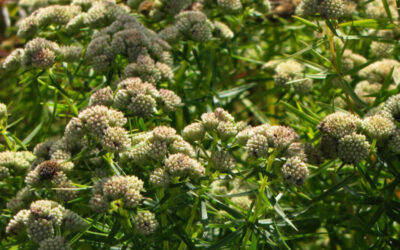
Pycnanthemum tenuifolium
Growing Information
• Plant Type: Perennial
• Sunlight: Sun, part shade
• Soils: Average, dry
• Bloom Time: White flowers in July, August, September
• Size: 8-20 inches in height; 12-36 inch spread
In addition to being a good garden plant with the narrow leaves and small white flower clusters Slender Mountain Mint stands out because of its above average attraction for pollinators. Plant in a perennial border, pollinator garden, rain garden, or near the vegetable garden to entice pollinators. The aromatic plant with shallow rhizomes is more aggressive than other Pycnanthemums so needs root pruning to keep from spreading. This is also called Narrow Leaved Mountain Mint and is native to Cape Cod.
Garden Companions
Sweet Black-eyed Susan (Rudbeckia hirta), Dense Blazing Star (Liatris spicata), Little Bluestem grass (Schizachyrium scoparium), Big Bluestem grass (Andropogon gerardii)
Nature Benefits
• Flowers attract a wide variety of pollinators.
• Larval host plant for Gray Hairstreak Butterfly.
Natural Habitat
Occurs in meadows and fields, dry rocky, open woods, pine barrens.
Pale Purple Coneflower
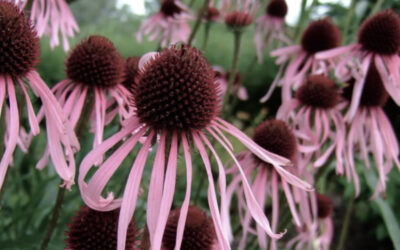
Echinacea pallida
Growing Information
• Plant Type: Perennial
• Sunlight: Sun, part sun
• Soils: Rich, dry to moist
• Bloom Time: Pale purple to pink flowers in June, July
• Size: up to 3 feet in height; 1 foot spread
Low maintenance and resilient with lance shaped drooping rays with a bold central reddish brown cone. Good planted with native grasses. Blooms earlier than purple coneflower so planted together gives many weeks of blooms. Many medicinal uses. Found on Cape Cod but not native here.
Garden Companions
Purple Coneflower (Echinacea purpurea), Butterfly Milkweed (Asclepias tuberosa), Little Bluestem (Schizachyrium scoparium), Wild Bergamot (Monarda fistulosa), Dense Blazing Star (Liatris spicata)
Nature Benefits
• Attracts bees and butterflies.
• Provides nectar for hummingbirds and butterflies.
• Goldfinches eat seeds.
• Wavy-Line Emerald Moth feeds on flower heads.
Natural Habitat
Occurs in old fields and roadsides, open wooded hillsides, and pinelands.

Purple Lovegrass
Eragrostis spectabilis
Growing Information
• Plant Type: Perennial
• Sunlight: Sun, part shade
• Soils: Poor, average to dry
• Bloom Time: Bronzy purple/red inflorescence in August, September
• Size: 8-14 inches in height; 10-16 inch spread
Plant this low, bunching grass with a mounding habit in sunny open perennial borders, meadows, or along roadsides. The inflorescence exhibits a fluffy texture giving a purple haze to the landscape when planted in groups. Provides erosion control on roadsides and hillsides. Native to Cape Cod.
Garden Companions
Eastern Prickly Pear Cactus (Opuntia humifusa), Flowering Spurge (Euphorbia corollata), Black-eyed Susan (Rudbeckia fulgida), White Wood-aster (Eurybia divaricata)
Nature Benefits
• Popular with insect herbivores such as leafhoppers
• Caterpillar host for the Zabulon Skipper
• Birds use dry panicles for nesting
Natural Habitat
Occurs in coastal beaches, meadows and prefers disturbed sandy areas.
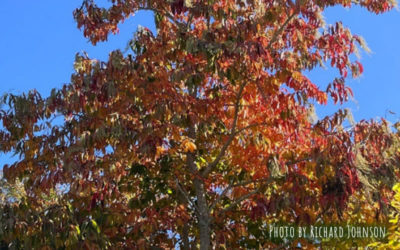
Sourwood
Oxydendrum arboreum
Growing Information
• Plant Type: Tree
• Sunlight: Sun, part shade
• Soils: Acidic, well-drained
• Bloom Time: July, August
• Size: 15 – 30 feet in height; 12 foot spread
This deciduous tree, while native to southwest Pennsylvania and states south, sourwood makes a good ornamental landscape tree on Cape Cod. It is in the heath family and its fragrant summer flowers are pollinated by insects and are a good source of nectar. Fall color is outstanding! Trees planted in the shade may grow taller and flower less. Salt tolerant and can withstand periodic droughts if established.
Garden Companions
Black Huckleberry (Gaylussacia baccata), Bayberry (Morella pensylvanica), Mountain Laurel (Kalmia latifolia)
Nature Benefits
• Attracts pollinators and butterflies
• Attracts songbirds
• Host plant of sphinx moths
Native Habitat
In its native range, found as single trees at forest edges, often within upland oak forests.
PHOTOS

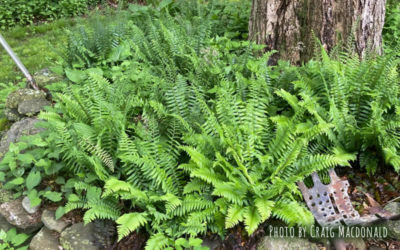
Christmas Fern
Polystichum acrostichoides
Growing Information
• Plant Type: Perennial
• Sunlight: Part to full shade
• Soils: Medium to Moist, well-drained
• Bloom Time: Not a flowering plant
• Size: 1-2 feet in height
This glossy green leathery fern is green year-round. It grows in clumps. Silvery fiddleheads appear in spring. It grows happily in the Cape’s sandy soils but likes it moist and shady. It will grow successfully under walnut trees. Great choice for accent, borders, mass planting as a groundcover, or as a potted plant.
Garden Companions
Violets (Viola sororia), Trout Lily (Erythronium americanum), Wild Columbine (Aquilegia canadensis), Wild Geranium (Geranium maculatum)
Nature Benefits
• Provides winter cover.
• Songbirds use parts of the plant for nesting material.
Native Habitat
Occurs in woods, stream banks, swamps, and thickets.
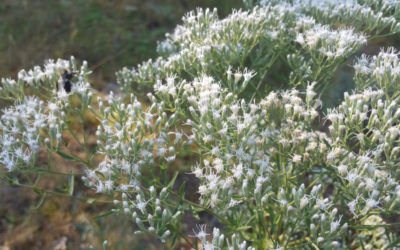
Hyssop-leaved Boneset
Eupatorium hyssopifolium
Growing Information
• Plant Type: Perennial
• Sunlight: Sun to Part
• Soils: Wet to dry soil conditions
• Bloom Time: White flowers in August, September
• Size: 2-4 feet in height
This meadow plant is a vase shaped perennial. Foliage is narrow and gray green. In late summer plants are covered with dense flat terminal clusters of white florets. The clouds of flowers attract a myriad of pollinators. This species thrives in well drained or dry sites. Good in a grouping or mass planting. Use in a cottage garden, rain garden, perennial border, or xeric-scape design. This is a true Cape Cod native.
Garden Companions
Black-Eyed Susan (Rudbeckia hirta), Purple Coneflower (Echinacea purpurea), Little Bluestem (Schizachyrium scoparium), Goldenrods (Solidago spp), Dense Blazing Star (Liatris spicata)
Nature Benefits
• Unappealing to deer and rabbits.
• A favorite of butterflies, bees, and other pollinators.
• Particularly important to beneficial insects.
Native Habitat
Occurs naturally in sandy soils of fields, roadsides, pondshores, and cranberry bog borrow pits.
Photos

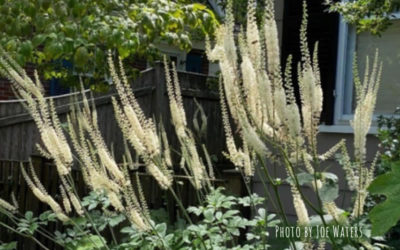
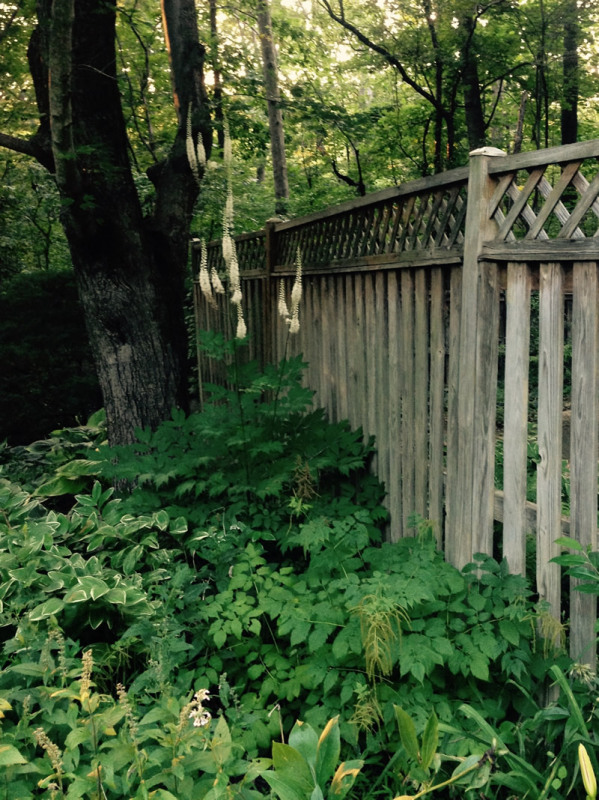
Black Cohosh / Bugbane
Actaea racemosa
Growing Information
• Plant Type: Perennial
• Sunlight: Partial sun, shade
• Soils: Moist, average
• Bloom Time: White spike flowers in June, July, August
• Size: 4-5 feet in height; 2-3 foot spread
Also known as black snakeroot with striking tall flower spikes and sharply divided foliage. It is an excellent choice for massing in a naturalistic garden. Flowering commences as spring wildflowers fade. Deer and rabbit resistant. Formerly Cimicifuga racemosa. Extremely rare in the wild in Massachusetts and some populations are introduced as escapes from gardens. Not found naturally on Cape Cod. Native to states west and south in the eastern U.S.
Garden Companions
Wild Geranium (Geranium maculatum), Blue Cohosh (Caulophyllum thalictroides), Joe Pye Weed (Eutrochium maculatum), Maple-leaved Viburnum (Viburnum acerifolium)
Nature Benefits
• Host plant for the Spring Azure.
• Attractive to pollinators.
Native Habitat
Occurs in forest edges and shady upland woods.
Photos
Smooth Sumac
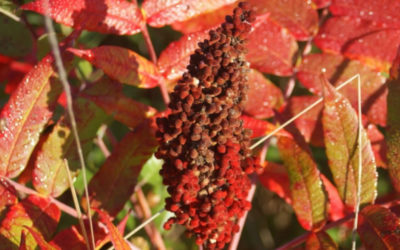
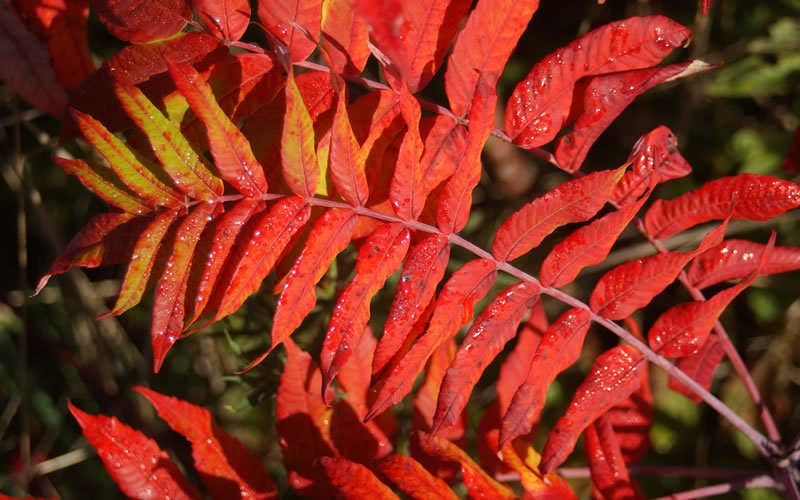
Rhus glabra
Growing Information
• Plant Type: Shrub
• Sunlight: Full Sun, Partial, Shade
• Soils: Medium to dry
• Bloom Time: June, July
• Size: 10-20 feet tall, spread 20 feet
Colony-forming shrub – most noticeable for its brilliant fall color and bright red fruit. The plant is dioecious and only the female plants produce fruit. Sumac is effective where it has room to establish in its natural drift form. Colonies can be rejuvenated by cutting to the ground in mid-winter every few years. Great for dry, tough locations, especially on slopes. Great plant for restoration projects.
Garden Companions
Other species of sumac, Common Ninebark (Physocarpus opulifolius)
Nature Benefits
• Flowers attract pollinators
• Berries provide food for many birds
• Provides wild bees nesting materials and structure for their life cycles
Native Habitat
Occurs in old fields, hardwood forest edges, and dry uplands.
Photos

Fragrant Sumac
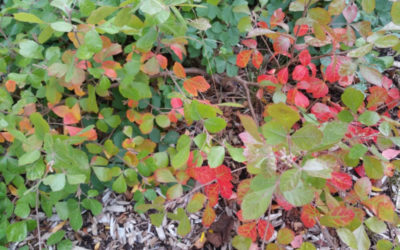
Rhus aromatica
Growing Information
• Plant Type: Shrub
• Sunlight: Full Sun, Partial
• Soils: Medium to dry
• Bloom Time: June, July
• Size: 2-6 feet tall, spread 6-10 feet
Good fast growing ground cover for banks and slopes. Can be massed or used in wind breaks. It suckers and roots where stems touch the ground and forms a dense stand. The straight species is usually tall and leggy in a garden setting, but the cultivar ‘Gro-Low’ is useful as a landscape plant for ground cover and stays no higher than three feet. Like all sumacs, it is dioecious, and fruit will only appear on female plants.
Garden Companions
Sweetfern (Comptonia peregrina), Little Bluestem Grass (Schizachyrium scoparium), Oakleaf Hydrangea (Hydrangea quercifolia), Flowering Dogwood (Cornus florida)
Nature Benefits
• Flowers attract pollinators
• Berries provide food for many birds and mammals
• Provides wild bees nesting materials and structure for their life cycles
Native Habitat
Occurs in old fields, hardwood forest edges, and dry uplands.
Photos

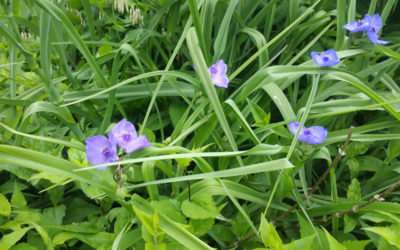
Spiderwort
Tradescantia ohiensis
Growing Information
• Plant Type: Perennial
• Sunlight: Full Sun, Partial
• Soils: Medium to dry
• Bloom Time: June, July
• Size: 2-4 feet tall
Its grass-like foliage grows in an upright form. The lavender blue flowers bloom from morning to midday, and close in the heat of the afternoon. This helps the plant conserve energy that can be put toward flowering for a longer period. A good choice for a rain garden.
Garden Companions
Foxglove Beardtongue (Penstemon digitalis), Wood Aster (Eurybia divaricata), Canada Anemone (Anemone canadensis)
Nature Benefits
• Attract pollinators and butterflies
Native Habitat
Occurs in fields and along roadsides.
Photos

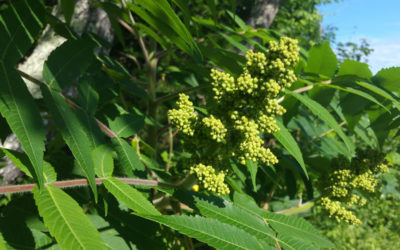
Staghorn Sumac
Rhus typhina
Growing Information
• Plant Type: Shrub
• Sunlight: Full Sun, Partial, Shade
• Soils: Medium to dry
• Bloom Time: June, July
• Size: 15-25 feet tall
Colony-forming shrub – most noticeable for its brilliant fall color and bright red fruit. The plant is dioecious and only the female plants produce fruit. Staghorn sumac is effective where it has room to establish in its natural drift form. Colonies can be rejuvenated by cutting to the ground in mid-winter every few years. Great for dry, tough locations, especially on slopes. Great plant for restoration projects.
Garden Companions
Other species of sumac, Common Ninebark (Physocarpus opulifolius)
Nature Benefits
• Flowers attract pollinators
• Berries provide food for many birds
• Provides wild bees nesting materials and structure for their life cycles
Native Habitat
Occurs in old fields, hardwood forest edges, and dry uplands.
Photos

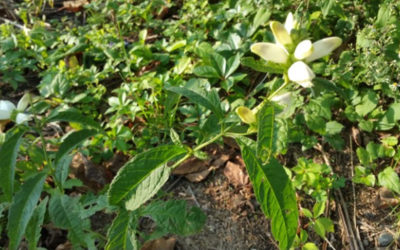
Turtlehead
Chelone glabra
Growing Information
• Plant Type: Perennial
• Sunlight: Sun, Part Sun
• Soils: Average, moist
• Bloom Time: White flowers in August
• Size: 2-4 feet in height
White Turtlehead is named for its distinctive flowers which are said to resemble a turtle’s head. It is mostly pollinated by bumblebees. In the wild, flower color can vary from pink to green. The vibrant Pink Turtlehead (Chelone lyonii) is often found in retail nurseries; however, this species of turtlehead is introduced to New England and is native to southeastern states. It appreciates a good, composted leaf mulch, particularly in sunny locations. A good choice for a rain garden.
Garden Companions
Red Cardinal Flower (Lobelia cardinalis), Great Blue Lobelia (Lobelia siphilitica), Rose Milkweed (Asclepias incarnata), Blue Flag Iris (Iris versicolor), and Coastal Plain Joe-pye Weed (Eutrochium dubium)
Nature Benefits
• Nectar source for hummingbirds and bumblebees
• Host plant for various species of moths and butterflies
Native Habitat
Occurs along shores of lakes, swamps, and wetland edges.
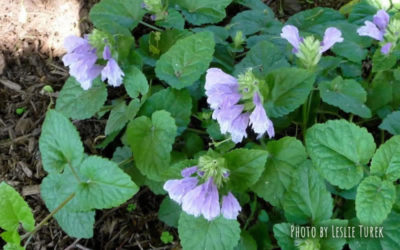
Meehan’s Mint
Meehania cordata
Growing Information
• Plant Type: Perennial
• Sunlight: Part shade, shade, sun
• Soils: Average, moist
• Bloom Time: Lavender blue in May, June
• Size: 4-8 inches in height; 4-32 inch spread
This rare well-behaved mint, with its trailing stems, will root as it spreads although less readily in dry shade than in moist shaded areas. Plant Meehan’s Mint as a groundcover, as living mulch under shrubs, or border edging in woodland or shade gardens. It prefers shade but tolerates dry sites in deep shade or full sun with sufficient moisture. This mint is not found in New England in the wild but is native to Pennsylvania and other states further to the south.
Garden Companions
Wild Columbine (Aquilegia canadensis), Plaintain Sedge (Carex plantaginea), Green and Gold (Chrysogonum virginianum)
Nature Benefits
• Nectar source for hummingbirds and insects
Native Habitat
Occurs in rich woods and wooded slopes.
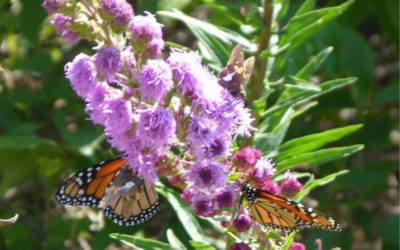
Dense Blazing Star
Liatris spicata
Growing Information
• Plant Type: Perennial
• Sunlight: Sun, part shade
• Soils: Average, moist
• Bloom Time: Purple flowers in July, August
• Size: 12-24 inches in height; 12-18 inch spread
Also known as gayfeather it has an upright habit taking little space to grow. Well-suited for a small gardens, perennial border, natural or wildlife garden, or planted in masses. It is the most moisture-tolerant of the Liatris species. Cherokee used the plant, especially roots, in herbal medicine. Popular garden plant although not a native to Cape Cod. Native range is eastern U.S., but from Pennsylvania to the south. Good choice for a rain garden.
Garden Companions
New England Aster (Symphyotrichum novae-angliae), Obedient Plant (Physostegia virginiana), Big Bluestem (Andropogon gerardii), Purple Coneflower (Echinacea purpurea)
Nature Benefits
• Attracts native bees and butterflies, birds, and hummingbirds
• Seeds provide forage for wildlife
• Nectar source for Silver Spotted Skipper (Epargyreus clarus), Painted Lady (Vanessa Cardui)
Native Habitat
Occurs in wood openings, moist prairies, and marsh edges.
Photos
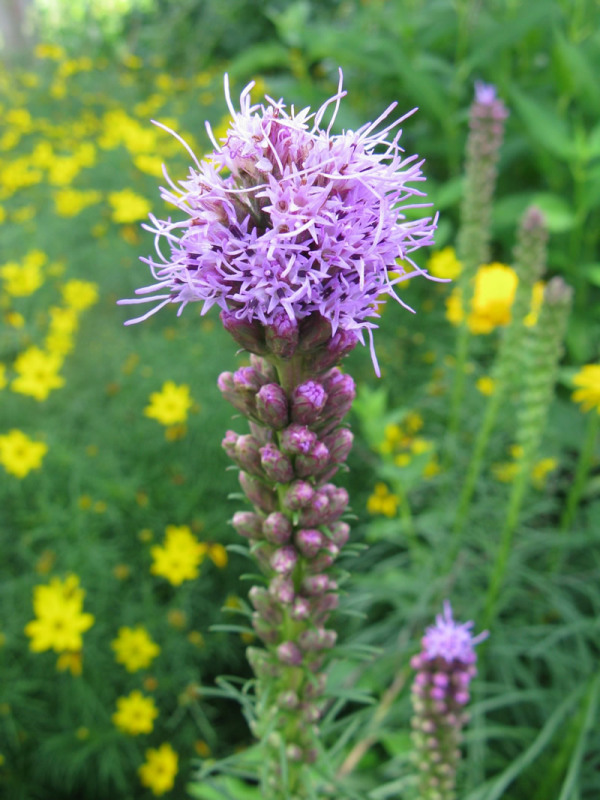
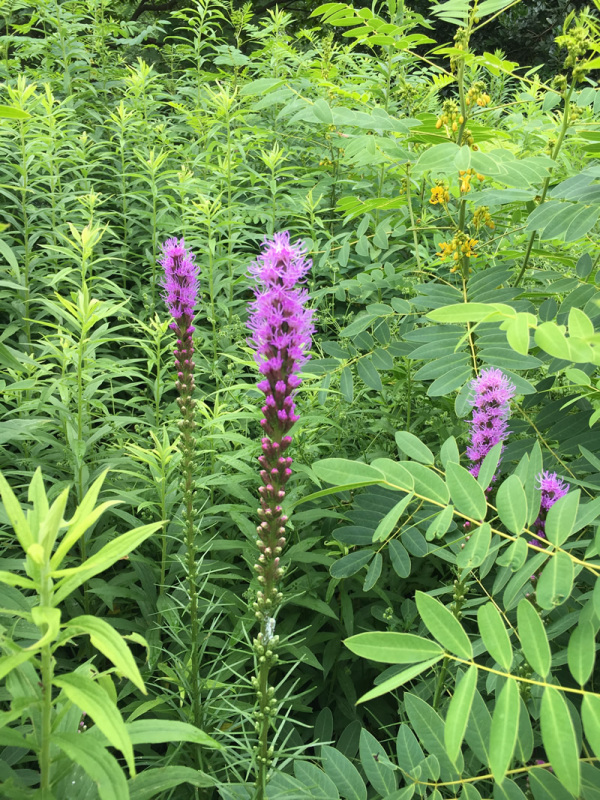
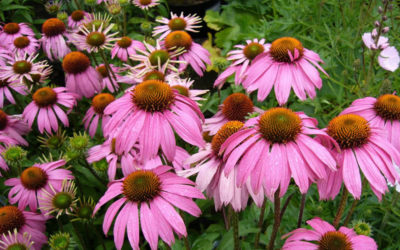
Purple Coneflower
Echinacea purpurea
Growing Information
• Plant Type: Perennial
• Sunlight: Sun, part shade
• Soils: Average, well-drained
• Bloom Time: Purple in July, August
• Size: 2-3 feet in height; 18-24 inch spread
Plant this easy-to-grow, drought tolerant wildflower in the perennial border or in masses. Native range includes New York and Pennsylvania and parts west. It is not a New England native, but it is a popular garden plant that does well on Cape Cod.
Garden Companions
Little Bluestem (Schizachyrium scoparium), Dense Blazing Star (Liatris spicata), Butterfly Milkweed (Asclepias tuberosa), Black-eyed Susan (Rudbeckia hirta), Obedient Plant (Physostegia virginiana)
Nature Benefits
• Nectar plant for native bees, butterflies, moths, beetles, flies, and wasps.
• Goldfinches eat seeds in the fall.
Native Habitat
Occurs in disturbed habitats, forest edges, and meadows.
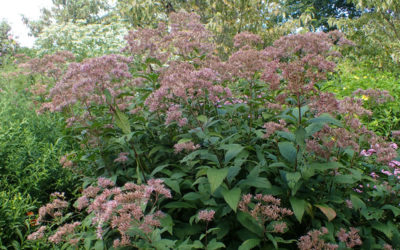
Spotted Joe Pye Weed – ‘Gateway’
Eutrochium maculatum
Growing Information
• Plant Type: Perennial
• Sunlight: Full sun to part shade
• Soils: Average
• Bloom Time: August, September
• Size: 4-5 feet in height
Not indigenous to Cape Cod, but native to much of the rest of New England. Plants can be cut back to half its height in early summer for late summer blooms on shorter stems. This plant is best showcased in masses or dramatic accent in a cottage or wildlife garden. Flower heads are 12” wide clusters of flowers that will dry to seedheads giving interest to a winter garden. Cut back in early spring leaving 6-18” remaining to provide hollow stems for wild bees. Good choice for rain gardens and meadows. Makes a good cut flower.
Garden Companions
Obedient Plant (Physostegia virginiana), Dense Blazing Star (Liatris spicata), Boneset (Eupatorium perfoliatum)
Nature Benefits
• Pollinator magnet
• Seeds are attractive to birds
Native Habitat
Occurs naturally in openings in marshes, meadows, and fields.
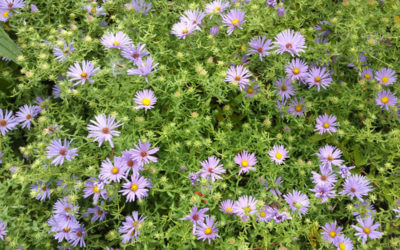
Aromatic Aster
Symphyotrichum oblongifolium
Growing Information
• Plant Type: Perennial
• Sunlight: Prefers full sun
• Soils: Prefers lean, medium-dry soil conditions
• Bloom Time: Light purple flowers in September, October, sometimes into November
• Size: 2 feet in height, stiff stems will branch out giving a bush-like appearance
Native to other parts of the country, this is an aster that can be easily found in retail nurseries to add to late flowering plants to support pollinators. It is the leaves that are aromatic on this
aster. When in bloom, the light purple flowers cover the bush-like plant and slowly bronze to a reddish purple. The plant may “open up” if it gets too top heavy, so a good prune in June is helpful. This aster does well in lean soils.
Garden Companions
Black-Eyed Susan (Rudbeckia hirta), Purple Coneflower (Echinacea purpurea), Little Bluestem (Schizachyrium scoparium)
Nature Benefits
• Highly resistant to deer and rabbits
• A favorite for butterflies and bees
Native Habitat
In its native range, it occurs in rocky and sandy soils such as those found in prairies and bluffs as well as in moist woodland habitats.
Blue Wood Aster / Heart-leaved Aster
Symphyotrichum cordifolium
Growing Information
• Plant Type: Perennial
• Sunlight: Partial shade, full shade, full sun
• Soils: Medium to medium-dry soil conditions
• Bloom Time: Light blue flowers in September, October
• Size: 3 feet in height; 1-2 foot spread
Blue Wood Aster has a wonderful array of dainty blue flowers that attract butterflies and bees. It is an excellent fall bloomer in a perennial border when others are starting to fade. It also makes an attractive cut flower and is a great naturalizer at the edge of woods.
Garden Companions
Black-Eyed Susan (Rudbeckia hirta), Purple Coneflower (Echinacea purpurea), Blue-stemmed Goldenrod (Solidago caesia)
Nature Benefits
• Root system is an effective erosion control on hillsides.
• Offers nectar and pollen for butterflies and bees.
• Supports specialist Adrenid Bees.
• Host plant for Pearl Crescent butterfly caterpillars.
Native Habitat
Occurs at the woodland edge, upland meadows, and forests.
Photo Gallery
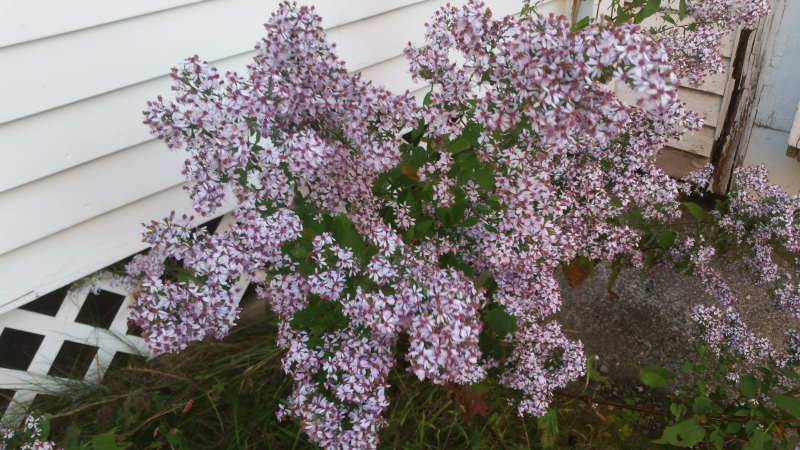
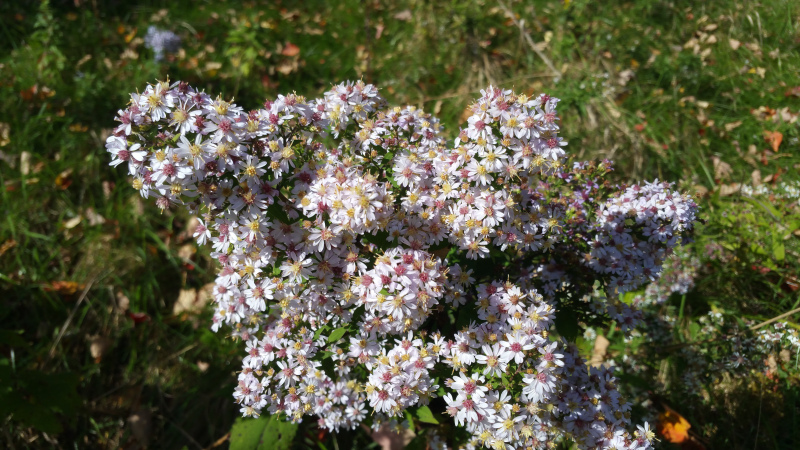
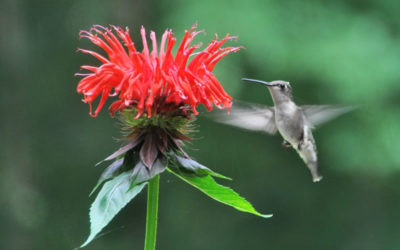
Scarlet Beebalm ‘Jacob Cline’
Monarda didyma ‘Jacob Cline’
Growing Information
• Plant Type: Perennial
• Sunlight: Sun, part shade
• Soils: Average, moist
• Bloom Time: Red in July, August
• Size: 3-4 feet in height; 3 foot spread
Plant in a wildlife or cut flower garden or meadow and enjoy the aromatic foliage and showy blooms. The Jacob Cline is common native beebalm cultivar that is resistant to powdery mildew and thrives, sometimes aggressively, in sunny, moist, well-drained soil. Also known as Oswego Tea because the leaves were used for tea by the Oswego Indians of New York. It is native to New York State and states south.
Garden Companions
Dense Blazing Star (Liatris spicata), Foxglove Beardtongue (Penstemon digitalis), Purple Coneflower (Echinacea purpurea), Culver’s Root (Veronicastrum virginicum), Little Bluestem (Schizachyrium scoparium)
Nature Benefits
• Nectar source for hummingbirds and swallowtail butterflies.
• Caterpillars of some moth species feed on the foliage.
Native Habitat
Occurs in moist open woods, meadows, stream banks.
Photos
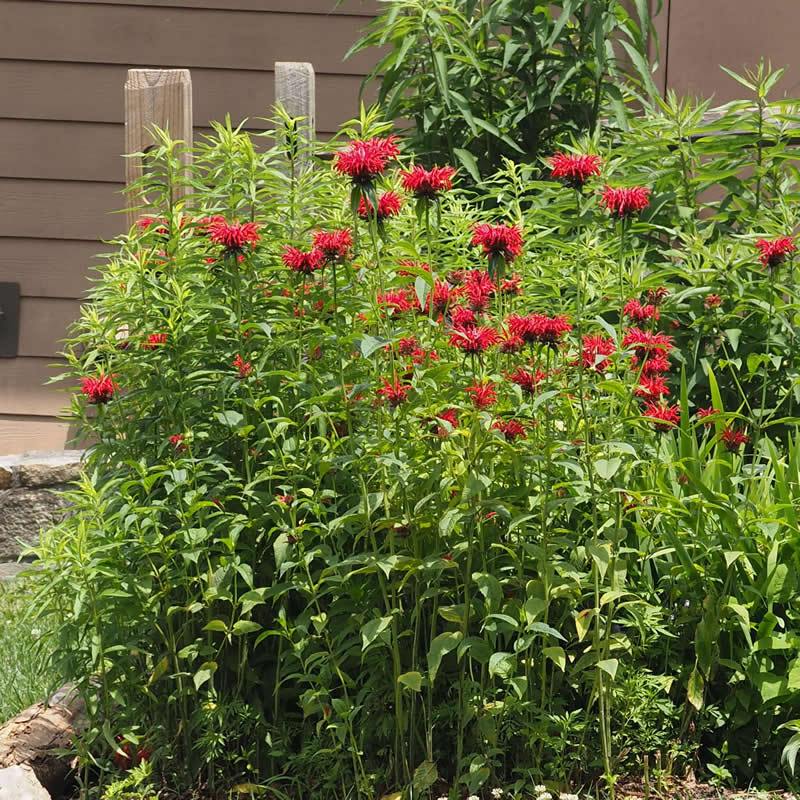
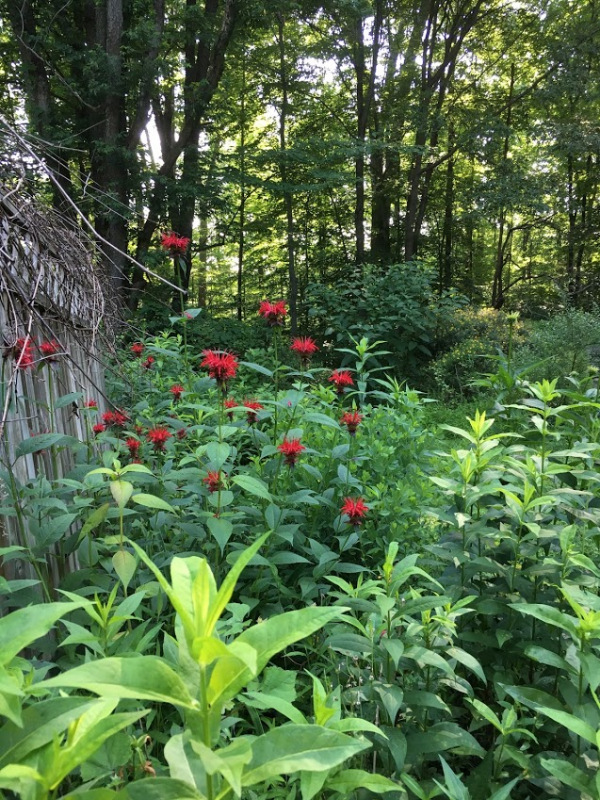
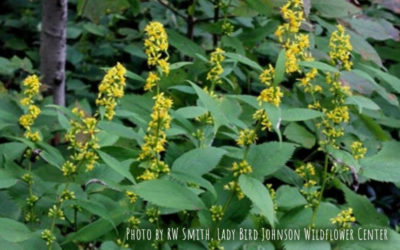
Zigzag Goldenrod
Solidago flexicaulis
Growing Information
• Plant Type: Perennial
• Sunlight: Sun, Part shade, shade, sun
• Soils: Average, dry, moist
• Bloom Time: Yellow in August, September, October
• Size: 1-3 feet in height; 1-3 foot spread
Compact pollinator plant that is shade tolerant and well-suited for a wildlife or shade garden or a natural area. Zigzag Goldenrod is good for massing and will spread by seed unless it is deadheaded. Does not require mulching because it is adapted to dry conditions. Semievergreen basal leaves provide erosion control.
Garden Companions
Goldenrods (Solidago spp.), Oxeye Sunflower (Heliopsis helianthoides), Blue Wood Aster (Symphyotrichum cordifolium)
Nature Benefits
• Seeds attract Swamp Sparrows, Pine Siskins, and Meadow Mice
• Host plants for some moth caterpillar species
• Nectar plant for native bees, wasps, butterflies, and pollinating flies
Native Habitat
Occurs in forests, protected slopes, wooded shores of rivers or lakes.
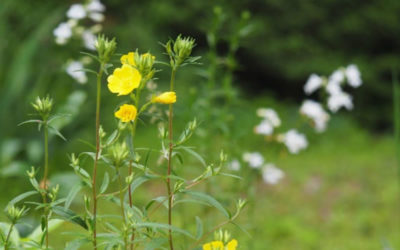
Sundrops
Oenothera fruticosa
Growing Information
• Plant Type: Perennial
• Sunlight: Sun, Part shade
• Soils: Average, well-drained
• Bloom Time: Yellow in May, June, July
• Size: 12-24 inches in height; 24-30 inch spread
Plant as a companion in a border or meadow. Also called narrow-leaf evening primrose it grows in challenging conditions and provides yellow flowers for months. It is a rapid spreader but not usually aggressive. This evening primrose blooms during the day rather than the evening.
Garden Companions
Greater Tickseed (Coreopsis major), Goldenrods (Solidago spp.)
Nature Benefits
• Attracts wide variety of bees, birds, butterflies
• Larval host for Sphinx moths
Native Habitat
Occurs along edges of salt marshes, brackish ponds, and tidal rivers.
Photos
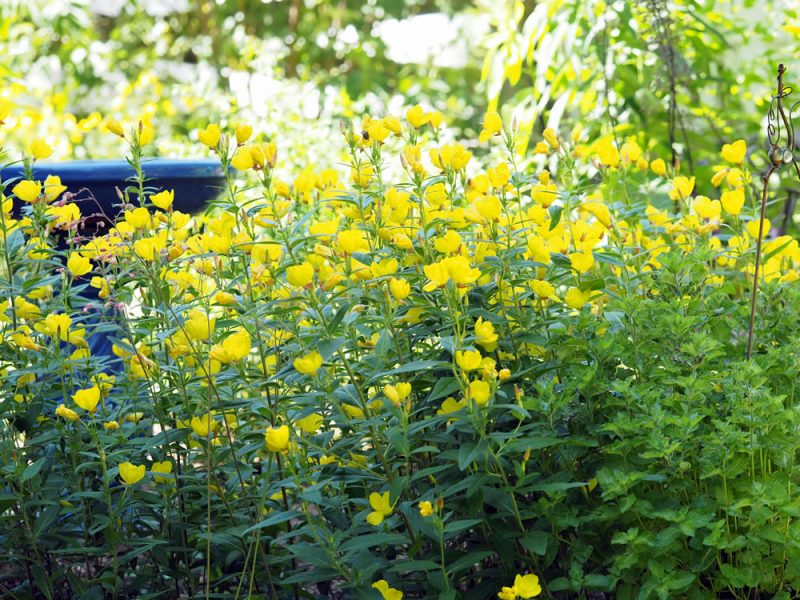
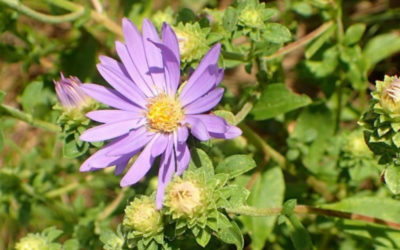
Showy Aster
Eurybia spectabilis
Growing Information
• Plant Type: Perennial
• Sunlight: Shade, Partial
• Soils: Medium to dry
• Bloom Time: August, September
• Size: 1-2 feet tall; 2 foot spread
Extremely drought tolerant. Plants are somewhat unpalatable to deer and rabbits. This plant will form small colonies, spreading by rhizomes, but it is not an aggressive spreader. A good addition to a pollinator garden, for mass plantings, cottage gardens and for naturalizing.
Garden Companions
Black-eyed Susan (Rudbeckia hirta), Anise-scented Goldenrod (Solidago odora), Pennyslvania Sedge (Carex pennsylvanica), Little Bluestem grass (Schizachyrium scoparium)
Nature Benefits
• Attracts pollinators
• Offers nectar for hummingbirds
Native Habitat
Occurs in woodlands.
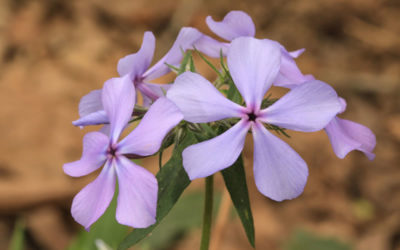
Wild Blue Phlox
Phlox divaricata
Growing Information
• Plant Type: Perennial
• Sunlight: Shade, Partial
• Soils: Medium to dry
• Bloom Time: May, June
• Size: 1-2 feet in height
This true native wild phlox has five petals and opposite leaves. It is a native to Connecticut, but not indigenous to Cape Cod. It spreads by its roots, but slowly. The showy flowers of blue to lavender attract pollinators making it an excellent addition to a pollinator garden. It is also an effective, shallow-rooted cover for early spring bulbs. A good plant for a small space.
Garden Companions
Lady Fern (Athyrium filix-femina), Wild Columbine (Aquigelia canadensis), Calico Aster (Symphyotrichum lateriflorum)
Nature Benefits
• Attracts pollinators
• Offers nectar for hummingbirds
Native Habitat
Occurs in woodlands.
PHOTOS
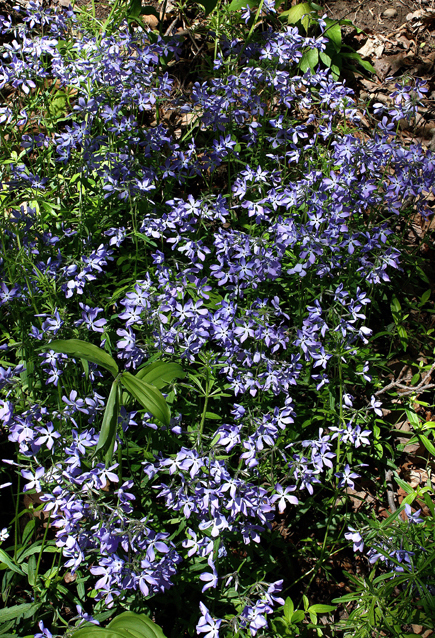
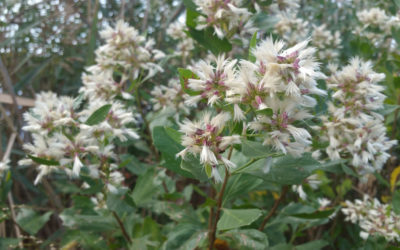
Groundsel Bush
Baccharis halimifolia
Growing Information
• Plant Type: Shrub
• Sunlight: Light shade to full sun
• Soils: Sandy to loamy, moist to wet, well-drained
• Bloom Time: August, September, October
• Size: 3-10 feet in height
Also called sea-myrtle or saltbush, inconspicuous flowers give way to fluffy white seed heads that burst open on female plants in the fall months. This shrub is highly salt tolerant and can withstand salt spray and periodic flooding as well as drought, making it a great shrub for coastal landscapes and for use in rain gardens. When the white seed heads pop into view in the fall around our salt marshes, everyone asks, “What is that plant?”
Garden Companions
Rose Mallow (Hibiscus moscheutos)
Nature Benefits
• Erosion control
• Flowers attract pollinating insects
• Dense branches provide shelter for birds and other wildlife
Native Habitat
Occurs naturally along salt marshes edges.
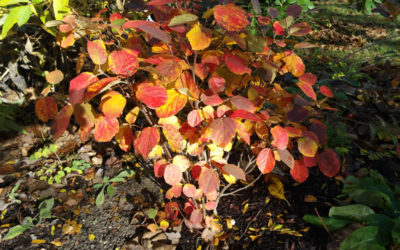
Dwarf Witch Alder
Fothergilla gardenii
Growing Information
• Plant Type: Shrub
• Sunlight: Sun to part shade
• Soils: Well-drained, Average
• Bloom Time: May, June
• Size: 1 to 3 feet in height
A native to the southeastern states, this deciduous shrub does well on Cape Cod. The white fragrant flowers are a mass of stamens that appear before the leaves in brushy terminal spikes. Its dense, dark green, leathery foliage becomes bright yellow to scarlet red for brilliant fall color and is resistant to deer and rabbits. Good for a low hedge, in a mixed shrub planting, foundation planting, or rain garden.
Garden Companions
Sweet Pepperbush (Clethra alnifolia), Low Bush Blueberry (Vaccinium angustifolium)
Nature Benefits
• Attracts bees and butterflies
Native Habitat
Occurs in woods and stream banks in states of the southeast.
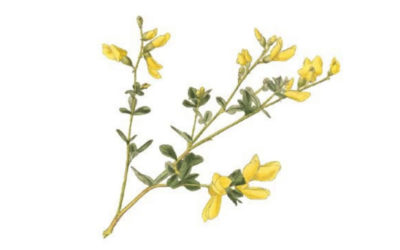
Yellow Wild Indigo
Baptisia tinctoria
Growing Information
• Plant Type: Shrub
• Sunlight: Full sun to part shade
• Soils: Well-drained average to dry
• Bloom Time: June, July
• Size: 2-3 feet tall with 2-3 foot spread
Yellow wild indigo is also called horsefly weed. It is an upright shrubby perennial with fine textured gray- green leaves and is drought tolerant. In late spring and summer, plants are adorned with many short clusters of bright or creamy yellow pea-shaped flowers. It thrives in harsh conditions and once established is durable and long lived. All Baptisia spp. are nitrogen-fixing legumes. They have a symbiotic relationship with the Rhizobium bacteria that allows them to utilize atmospheric nitrogen.
Garden Companions
Butterfly Milkweed (Asclepias tuberosa), Purple Coneflower (Echinacea purpurea), Black-eyed Susan (Rudbeckia hirta), Showy Goldenrod (Solidago speciosa)
Nature Benefits
• Plants host caterpillars of Frosted Elfin, Wild Indigo Duskywing and Orange Sulfur butterflies as well as the caterpillars of other moths and skippers.
Native Habitat
Occurs in dry meadows, oak barrens, pine barrens, open woods, and fields.
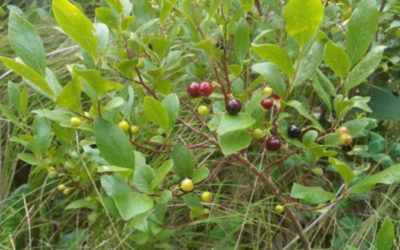
Black Huckleberry
Gaylussacia baccata
Growing Information
• Plant Type: Shrub
• Sunlight: Sun, Part Shade, Shade
• Soils: Dry, moist
• Bloom Time: Spring blossoms – April, May, June
• Size: 1-2 feet in height
Gaylussacia baccata closely resembles the native blueberry plants (Vaccinium species) with which it grows in the same habitats. However, it can be readily identified by the numerous resin dots on the undersides of the leaves that glitter when held up to the light. Flowers are in dangling groups of 3–7, orange or red, bell-shaped. Berries are dark blue to black when ripe. Berries are sweet and tasty. People and animals eat them raw, jellied, or in baked items.
Garden Companions
Lowbush Blueberry (Vaccinium angustifolium), Mountain Laurel (Kalmia latifolia), Sassafras (Sassafras albidum), Wintergreen (Gaultheria procumbens)
Nature Benefits
• The fruit and twigs on this shrub are used by many forms of wildlife and attracts birds.
• Many species of butterflies visit the bell-like flowers for nectar.
Native Habitat
Occurs in dry or moist open woods.
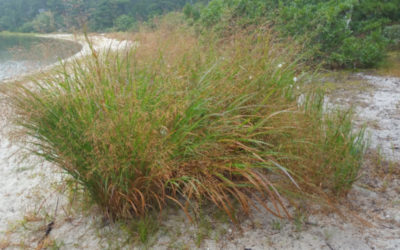
Switchgrass
Panicum virgatum
Growing Information
• Plant Type: Grass
• Sunlight: Full Sun, part
• Soils: Dry, average
• Bloom Time: Purplish in summer and early fall
• Size: 2-5 feet in height; 2-4 foot spread
A robust, warm season bunchgrass, switchgrass is best used as a striking accent in landscapes. Seed heads are an airy cloud in late summer with golden fall foliage. Very drought tolerant once established. Rigid stems stand upright throughout the winter. Grasses give movement to the garden design. Cultivars, “Shenandoah” and “Cape Breeze”, are commonly found at retail nurseries.
Garden Companions
Little Bluestem (Schizachyrium scoparium), Butterfly Milkweed (Asclepias tuberosa), Black-eyed Susan (Rudbeckia fulgida), Goldenrods (Solidago species), Aromatic Aster (Symphotrichum oblongifolium).
Nature Benefits
• Seeds are eaten by ground-feeding songbirds and game birds.
• Provides cover and nesting material for birds.
• Host for most banded skipper butterflies and the Delaware skipper.
• Deer resistant.
Native Habitat
Occurs along roadsides and upland pond edges.
PHOTOS
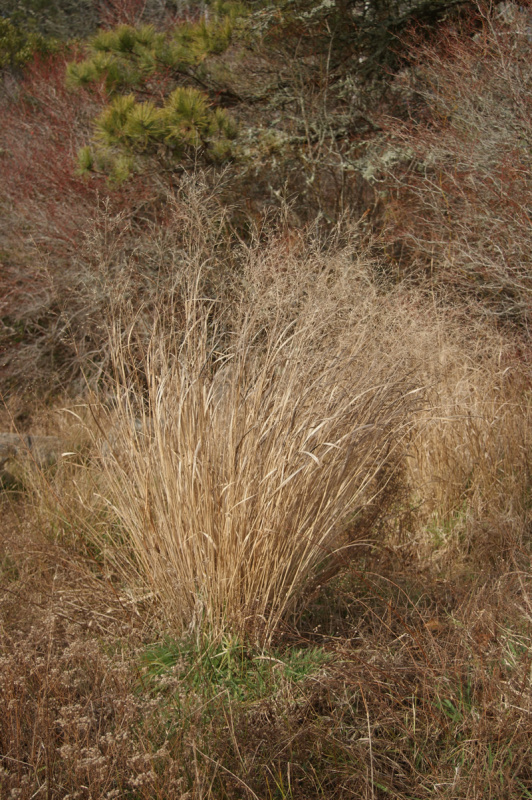
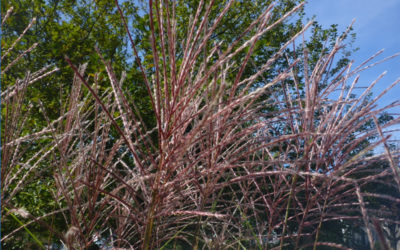
Big Bluestem
Andropogon gerardii
Growing Information
• Plant Type: Grass
• Sunlight: Full Sun
• Soils: Dry, average
• Bloom Time: Purplish in summer and early fall
• Size: 2-5 feet in height; 2-4 foot spread
A robust, warm season bunchgrass, Big Bluestem is best used as a striking accent in meadow landscapes. Silver tufts of seeds in late summer, contrast with golden fall foliage. Very drought tolerant once established.
Garden Companions
Little Bluestem (Schizachyrium scoparium), Butterfly Milkweed (Asclepias tuberosa), Black-eyed Susan (Rudbeckia hirta), Goldenrods (Solidago species)
Nature Benefits
• Host plant for at least eleven native butterflies and moths
• Attracts songbirds
• Valuable to a range of insects, birds, and mammals
Native Habitat
Occurs in low meadows and moist grasslands
PHOTOS

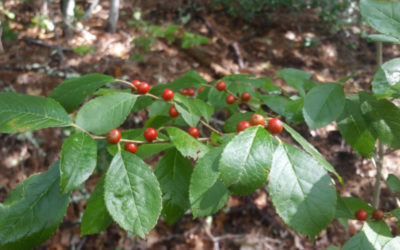
Winterberry
Ilex verticillata
Growing Information
• Plant Type: Shrub
• Sunlight: Sun, part shade, shade
• Soils: Moist, medium wet, medium, dry (once established)
• Bloom Time: White flowers in June
• Size: 6-10 feet in height
Known for its stunning red berries in the late fall over the winter. Like any holly, it is dioecious, and berries are born on female plants provided there is a male plant within about 50 feet. Pollen is carried by the wind. Popular paired cultivars are ‘Jim Dandy’ (male plant grows to 5ft) and ‘Red Sprite’ (female plant matures at 3-4ft).
Garden Companions
Ink berry (Ilex glabra), Arrowwood (Viburnum dentatum), Red Osier (Cornus sericea)
Nature Benefits
• Berries are eaten by many songbirds in the winter.
• In its mature size, provides desirable nesting habitat.
Native Habitat
Occurs at wetland edges, pond edges, and vernal pools.
PHOTOS
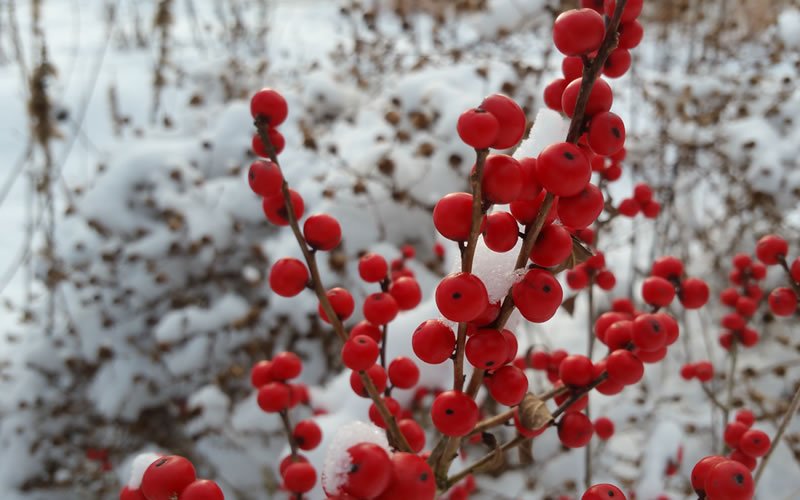
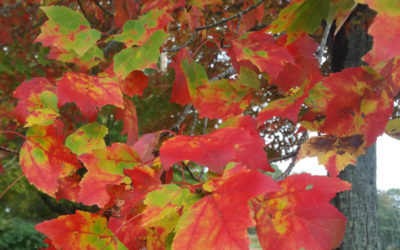
Red Maple
Acer rubrum
Growing Information
• Plant Type: Tree
• Sunlight: Sun
• Soils: Moist to average to dry
• Bloom Time: April
• Size: Tall
Considered a keystone species because of its value to a diverse number of insect and animal species. Red maple is known for its beautiful fall color. It can tolerate a wide range of soils, variable pH and even pollution, and therefore should be considered for use as a street tree, parks, and in rain gardens.
Garden Companions
Black chokeberry (Aronia melanocarpa); American Hazelnut (Corylus americana); Anise-scented Goldenrod (Solidago odoro); New England aster (Symphyotrichum novae-angliae); Beardtongue (Penstemon digitalis)
Nature Benefits
• Host for over 275 species of moth and butterfly caterpillars.
• Spring flowers offer nectar and pollen for a variety of insects.
• Seeds provide food for both birds and mammals.
Native Habitat
Occurs in lowlands and wetlands but can also be found in hardwood forests.
Photos
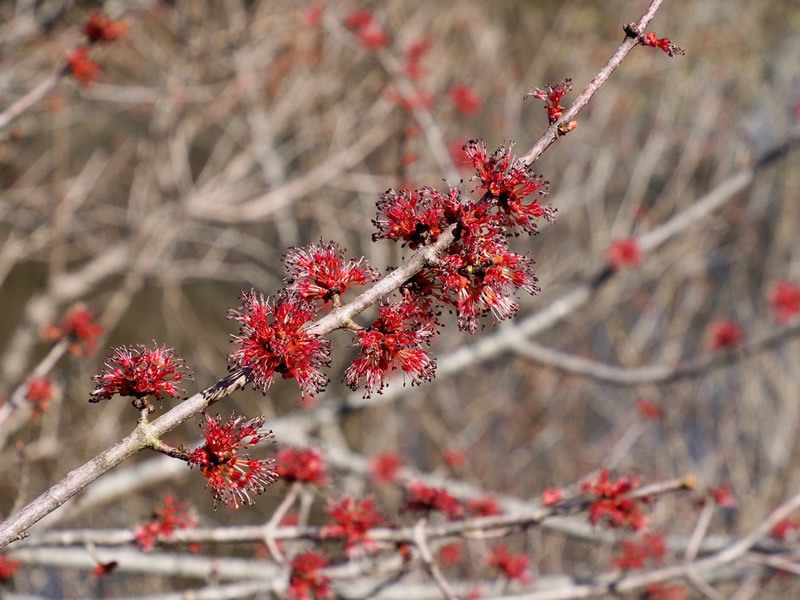
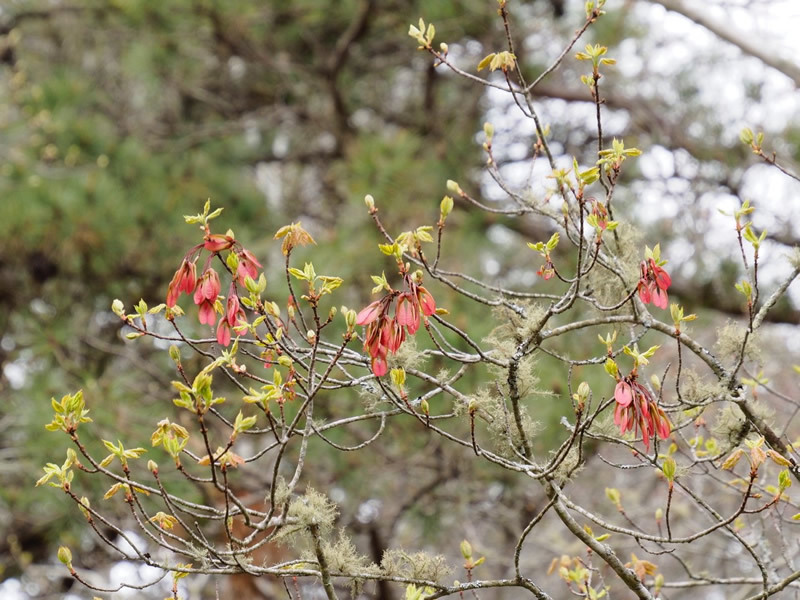
Tulip Tree
Liriodendron tulipifera
Growing Information
• Plant Type: Tree
• Sunlight: Sun
• Soils: Average moisture
• Bloom Time: June
• Size: Tall
Considered a shade tree, the tulip tree is one of the tallest hardwoods in North America. It gets its name from the shape of its flower and the shape of the leaf looks like the outline of a tulip. If out in the open, the shape of the tree is pyramidal. This tree is fast growing and can live 175 years.
Garden Companions
Black chokeberry (Aronia melanocarpa); American Hazelnut (Corylus americana); Anise-scented Goldenrod (Solidago odoro); Mountain Mint (Pycnanthemum muticum); Beardtongue (Penstemon digitalis)
Nature Benefits
• Host for 20 species of moth and butterfly caterpillars, including the tulip tree silk moth.
• Ruby-throated hummingbirds and bees seek out the flowers for early season forage.
• Seeds mature in summer and persist into winter, providing food for both birds and mammals, including finches, cardinals, quail, and small mammals.
Native Habitat
Occurs in lowlands and gentle sloping hillsides.
Photos
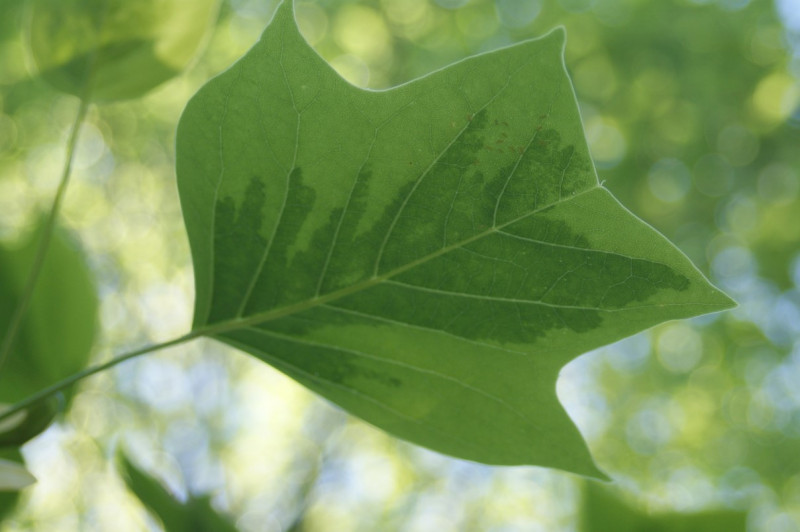
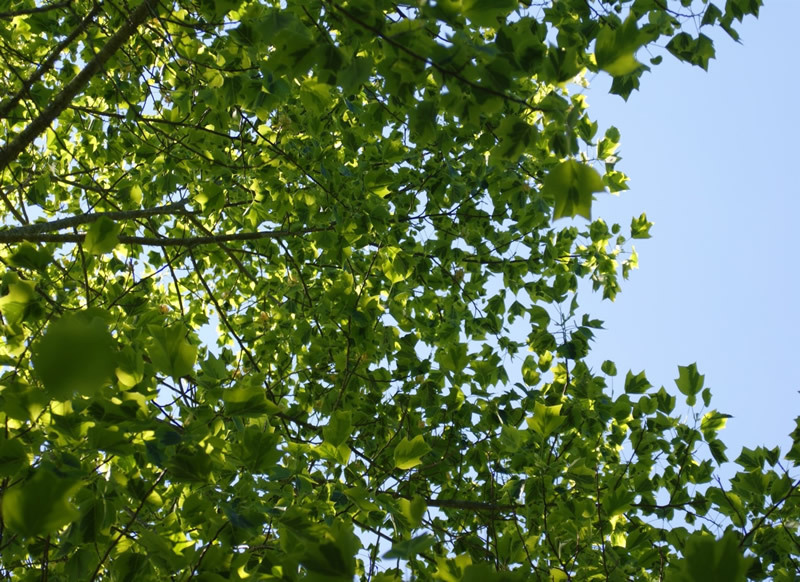

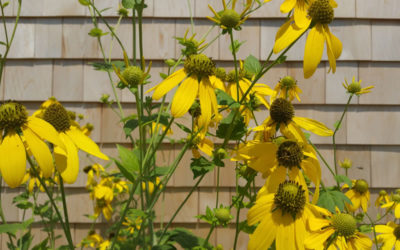
Cutleaf Coneflower
Rudbeckia laciniata
Growing Information
• Plant Type: Perennial
• Sunlight: Sun, Partial, Shade
• Soils: Dry to moderate moisture
• Bloom Time: Yellow flowers July, August
• Size: 5-6 feet in height; 3 foot spread
Also called green-headed coneflower. Because it spreads rampantly by underground stems, cut-leaf coneflower is only appropriate for large sites. May need staking in garden situations but otherwise very hardy.
Garden Companions
Black-eyed Susan (Rudbeckia fulgida or Rudbeckia hirta)
Nature Benefits
• Pollinator magnet.
• Attracts birds.
Native Habitat
Occurs on shorelines of lakes and rivers and swamps.
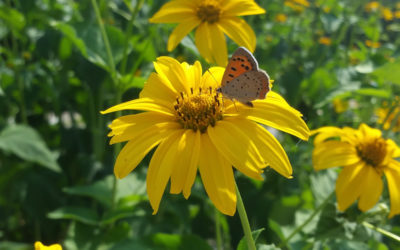
Ox-eye Sunflower
Heliopsis helianthoides
Growing Information
• Plant Type: Perennial
• Sunlight: Sun, Part Sun
• Soils: Average, Moist or Dry
• Bloom Time: Yellow flowers in July, August, September
• Size: 3-5 feet in height; 1-3 foot spread
Useful for accent, mass or grouping. Excellent for a wildlife garden or meadow. Plants provide showy blooms and erosion control. Appropriate for cottage gardens, water-wise landscapes, low maintenance plantings, perennial borders, and shade gardens.
Garden Companions
Wild Bergamot (Monarda fistulosa), White Snakeroot (Eupatorium coelestinum), Blazing Star (Liatris spicata)
Nature Benefits
• Pollinator powerhouse!
• Goldfinches and other songbirds relish the seeds.
Native Habitat
Occurs in open woods, woodland borders, grassy meadows, stream banks, disturbed roadsides.
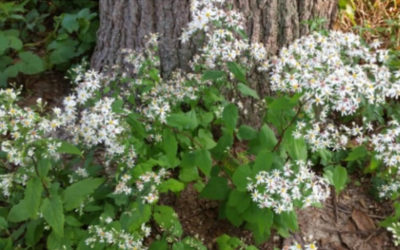
White Wood Aster
Eurybia divaricata
Growing Information
• Plant Type: Perennial
• Sunlight: Part shade, Shade
• Soils: Average, Moist or Dry
• Bloom Time: White flowers in August, September
• Size: 1-2 feet in height
Plant as a groundcover, border, or accent plant—it is an especially great choice for dry shade and under trees. Readily spreads by seeds and will fill in, but easily controlled by cutting seed heads or easy weeding. This plant is unpalatable to rabbits and deer.
Garden Companions
White Snakeroot (Ageratum altissima), Wild Geranium (Geranium maculatum), Blue-stemmed Goldenrod (Solidago caesia), King Solomon’s Seal (Polygonatum biflorum), Wild Columbine (Aquilegia canadensis)
Nature Benefits
• Host plant for the caterpillar stage of the Pearl Crescent and Checkerspot butterflies.
• Provides nectar for pollinators.
Native Habitat
Occurs in dry open woodlands and woodland edges.
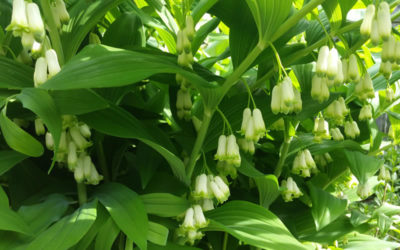
King Solomon’s Seal
Polygonatum biflorum
Growing Information
• Plant Type: Perennial
• Sunlight: Shade, part shade
• Soils: Average, moist
• Bloom Time: White bell-shaped flowers in May, June
• Size: 12-42 inches in height; 16-24 inch spread
Arching stems and vertical character provide a refined look to woodland, wild, rock, or native plant gardens. Golden leaves in fall contrast with round fruit to add interest. Grows well at base of trees. Drought tolerant and rabbit resistant.
Garden Companions
Wild Ginger (Asarum canadense), Foam Flower (Tiarella cordifolia), Virginia Bluebells (Mertensia virginica), Wild Strawberry (Fragaria virginiana), Wild Columbine (Aquilegia canadensis), Ostrich Fern (Matteuccia struthiopteris), Maidenhair Fern (Adiantum pedatum)
Nature Benefits
• Fruit attracts birds.
• Flowers attract pollinators.
Native Habitat
Occurs in forest edges, forests, meadows, fields, woodlands.
Photos
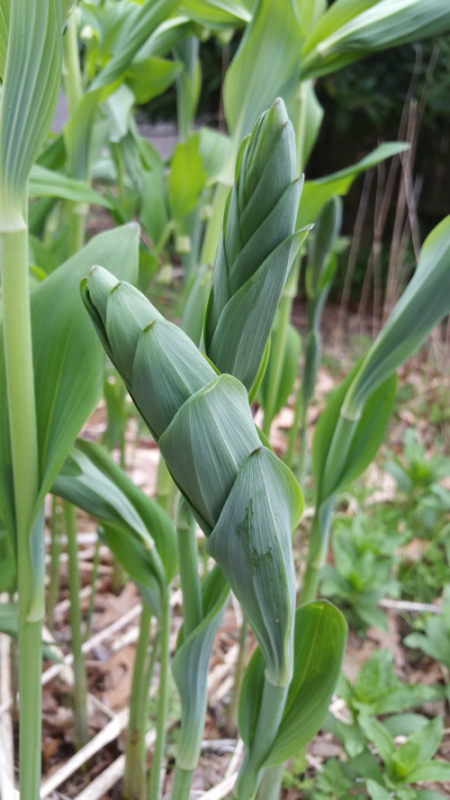
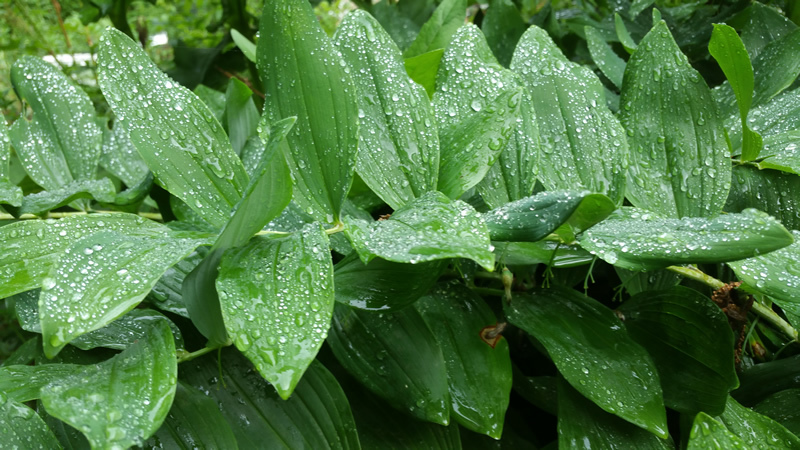
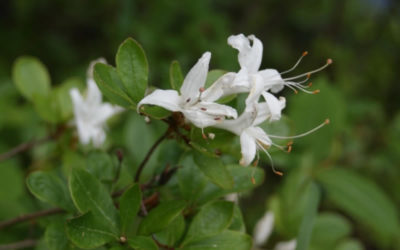
Swamp Azalea
Rhododendron viscosum
Growing Information
• Plant Type: Shrub
• Sunlight: Shade, part shade
• Soils: Average, moist
• Bloom Time: White in June, July
• Size: 3-5 feet in height; 3-5 feet spread
Plant Swamp Azalea as a hedge, in a mixed border, native plant garden, or in a foundation planting. The flowers appear after the leaves which have good fall color. It is one of the latest azaleas to bloom and the most fragrant. Its corolla is covered with sticky glands.
Garden Companions
Royal Fern (Osmunda regalis), Cinnamon Fern (Osmundastrum cinnamomeum), Great Blue Lobelia (Lobelia siphilitica), Sweet Pepperbush (Clethra alnifolia), Inkberry (Ilex glabra)
Nature Benefits
• Attracts birds and bumble bees
• Host plant for caterpillars
Native Habitat
Occurs in shores of rivers or lakes, swamps.